Small Group vs 1-to-1 English Classes in Singapore: Which Is Better?


If you are planning to improve your English in Singapore, one of the first decisions you will face is whether to choose small group English classes or 1-to-1 private English lessons.
Both options are popular among adult learners, working professionals, expatriates and international residents.
Some learners believe that private lessons must be more effective because they receive the teacher's full attention.
Others prefer small group English classes because they are generally more affordable and provide opportunities to communicate with different people.
But which learning format actually helps you improve your English faster?
And which offers better value for money?
The answer depends on your current English level, learning goals, budget, schedule and preferred learning environment.
For example, someone preparing for an important business presentation may benefit from personalised private coaching.
However, someone who wants to feel more confident in everyday conversations may benefit greatly from interacting with classmates in a small group.
In this guide, we compare small group and 1-to-1 English classes in Singapore across the factors that matter most:
Speaking practice and fluency
Learning speed and effectiveness
Personalised feedback
Listening and pronunciation
Business English
Confidence and communication skills
Lesson fees and value for money
Scheduling flexibility
Suitability for different English levels
By the end, you will have a clearer understanding of which learning format is right for you.
1. What Are Small Group English Classes?
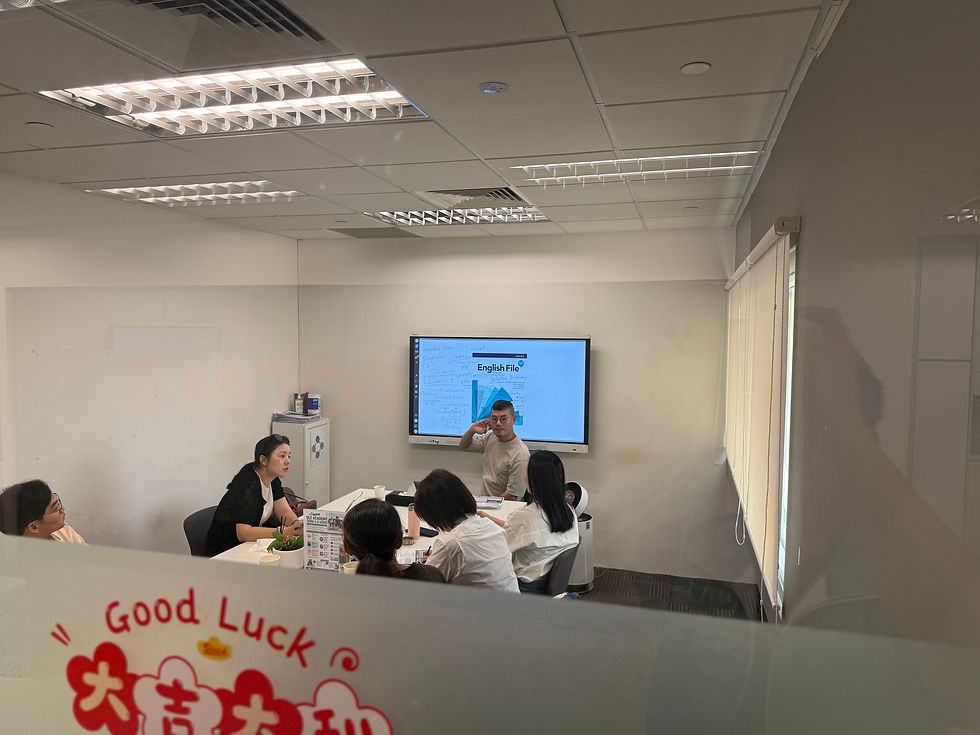
Small group English classes are lessons in which one teacher works with a limited number of students.
Unlike large classroom programmes, small group lessons are designed to allow more interaction between teachers and learners.
A typical small group English lesson may include:
Everyday English conversations
Pair discussions
Group discussions
Role-playing activities
Listening exercises
Vocabulary development
Grammar practice
Pronunciation exercises
Short presentations
For example, during a lesson about travelling, students may practise conversations between hotel staff and guests.
Student A:
“Do you have any rooms available for tonight?”
Student B:
“Yes, we have a double room available.”
Students can then switch roles and practise different responses.
These activities allow learners to apply vocabulary and grammar in realistic communication situations.
The biggest advantage of small group English classes
The main benefit is the opportunity to practise communicating with different people in a structured and supportive learning environment.
For adults who want to improve their conversational English, this can be particularly valuable.
2. What Are 1-to-1 English Lessons?
1-to-1 English lessons, also known as private English lessons, involve one teacher working with one student.
Because the teacher focuses on a single learner, the lesson can be adapted to individual needs.
For example:
A complete beginner may need to focus on basic vocabulary, sentence structures and pronunciation.
A business professional may need to practise meetings, negotiations and presentations.
An IELTS candidate may need targeted speaking practice and feedback.
A student who understands English but struggles to speak may need intensive conversation exercises.
Private lessons allow the teacher to adjust the lesson content, pace and difficulty according to the learner's progress.
The biggest advantage of 1-to-1 English lessons
The main benefit is personalised instruction.
Students can focus on specific weaknesses and receive more individual feedback.
However, personalised teaching does not automatically guarantee better results.
The quality of the lessons and the student's participation still matter.
3. Small Group vs 1-to-1 English Classes: Quick Comparison
Feature | Small Group English Classes | 1-to-1 English Lessons |
Class size | Small number of students | One teacher and one student |
Personalisation | Some individual support within a shared curriculum | Highly personalised |
Teacher attention | Shared among students | Focused on one student |
Speaking practice | Conversations with teachers and classmates | Intensive conversations with the teacher |
Group discussions | Excellent opportunity | Limited |
Pronunciation correction | Available during activities | More focused individual correction |
Learning pace | Generally follows the group's progress | Can be adjusted individually |
Business English | Useful for general workplace communication | Useful for specific professional situations |
Social interaction | Opportunities to meet other learners | Mainly teacher-student interaction |
Scheduling | Usually follows a class timetable | May offer greater flexibility |
Cost per hour | Generally lower | Generally higher |
Best suited for | Practical communication and ongoing learning | Specific goals and personalised coaching |
Neither option is automatically better.
The right choice depends on what you want to achieve.
4. Which Is Better for Improving English Speaking Skills?
For many adult learners, speaking confidently is the main reason for taking English classes.
However, speaking ability involves more than simply producing correct sentences.
You also need to develop fluency, listening comprehension, pronunciation, confidence and the ability to respond naturally.
Choose 1-to-1 lessons for intensive individual speaking practice
In a private lesson, the teacher can direct questions and feedback entirely towards you.
For example:
Teacher: “What do you usually do after work?”
Student: “I usually go home and watch TV.”
The teacher can continue:
“What kind of programmes do you watch?”
“Why do you enjoy them?”
“Do you prefer staying at home or going out with friends?”
This approach helps students practise expanding their answers instead of giving short responses.
The teacher can also identify recurring problems and adjust the questions accordingly.
Private lessons can be particularly useful if you want to maximise individual speaking practice.
Choose small group classes for real-world communication
In everyday life, you rarely communicate with only one person.
You may need to speak with:
Colleagues from different countries
Customers with different accents
Other parents at your child's school
New friends
Business partners
Several people during meetings
Small group classes provide opportunities to practise these interactions.
For example, during a discussion about remote working:
Student A: “I think working from home is more productive.”
Student B: “I disagree because I find it easier to concentrate in the office.”
Student C: “I think it depends on the type of job.”
This type of interaction develops important communication skills.
Students learn how to listen, respond, agree, disagree, ask questions and participate in conversations.
The key difference is that private lessons focus on individual speaking practice, while small group lessons offer more opportunities for communication with different people.
5. Which Type of English Class Helps You Improve Faster?
Many learners assume that 1-to-1 lessons always produce faster results.
However, English learning progress depends on several factors.
These include:
Your current English proficiency
Your learning objectives
The teacher's experience and teaching methods
The quality of the lesson activities
How frequently you attend lessons
Your independent practice
How often you use English outside the classroom
Consider two learners.
The first attends interactive small group English classes twice a week and regularly practises speaking outside the classroom.
The second attends one private lesson each week but rarely practises between sessions.
It would be incorrect to assume that the second learner will necessarily improve faster.
Private lessons may provide more targeted instruction, but consistent practice is essential in either format.
The most effective English course is one that provides appropriate practice, useful feedback and a learning routine you can maintain.
6. Which Is Better for Complete English Beginners?
Both formats can work for beginners.
The best choice depends on your confidence, learning preferences and the availability of classes at your level.
When 1-to-1 lessons may be better
Private lessons may be suitable if you:
Have almost no English foundation
Need to start with basic pronunciation
Prefer explanations at your own pace
Feel uncomfortable learning with other students
Need repeated grammar explanations
Want to focus on specific basic communication skills
A beginner may start with expressions such as:
“My name is…”
“I live in Singapore.”
“I would like a cup of coffee.”
“Could you speak more slowly, please?”
The teacher can repeat or adjust exercises based on your understanding.
When small group classes may be better
Beginner-level small group classes can also be effective.
Learning with classmates at a similar level may help you feel more comfortable.
You can practise short conversations together and learn from questions raised by other students.
For example, students may practise introducing themselves:
“Where are you from?”
“How long have you lived in Singapore?”
“What do you like doing in your free time?”
The important factor is not simply the number of students.
It is whether the lesson is suitable for your English level.
7. Which English Class Is Best for A2, B1 and B2 Learners?
Your CEFR English level can help guide your decision.
English Level | Typical Learning Goals | Suggested Learning Format |
A1 Beginner | Basic vocabulary, pronunciation and sentences | Beginner small group or private lessons |
A2 Elementary | Everyday communication and simple conversations | Small group or targeted private support |
A2+ Pre-Intermediate | Longer sentences and greater confidence | Conversation-focused small group or private lessons |
B1 Intermediate | Fluency, spontaneous responses and fewer pauses | Small group speaking or 1-to-1 coaching |
B1+ Intermediate Plus | Discussion skills and more varied expressions | Group discussions with targeted feedback |
B2 Upper-Intermediate | Business communication and complex opinions | Small group or specialised private lessons |
C1 Advanced | Precision, professional communication and presentations | Goal-specific private lessons or advanced discussion |
A2+ and B1+ are commonly used teaching subdivisions rather than separate official CEFR levels.
Students at the same level may also have different strengths and weaknesses.
For example, one B1 learner may understand conversations well but struggle to speak.
Another B1 learner may speak confidently but make frequent grammatical mistakes.
This is why taking an English placement test before choosing a course can be helpful.
8. Which Is Better If You Feel Nervous Speaking English?
Many adults understand English but feel uncomfortable speaking it.
Common concerns include:
Making grammar mistakes
Having an unfamiliar accent
Being judged by classmates
Forgetting vocabulary
Not understanding questions
Taking too long to respond
There are two useful approaches.
Approach A: Build confidence through private lessons
If speaking in front of others causes significant anxiety, 1-to-1 lessons may provide a more comfortable starting point.
You can practise basic conversations and gradually develop confidence.
Later, you may join a small group class to practise with different people.
Approach B: Develop confidence through small group interaction
If you want to become comfortable speaking in front of others, a supportive small group class can provide valuable practice.
You can learn that communication does not require perfect grammar.
You can also become more comfortable responding to different people.
Neither approach is universally better.
The goal is to build confidence through manageable and repeated speaking experiences.
9. Which Is Better for Improving English Listening Skills?
The answer depends on why listening is difficult.
Situation 1: You do not understand basic vocabulary or grammar
Private lessons may help you address these foundational weaknesses.
Situation 2: You understand your teacher but struggle with other speakers
Small group classes may expose you to a wider range of accents, speaking styles and expressions.
Situation 3: You understand one speaker but struggle during group conversations
Group discussions may help you practise following multiple speakers and identifying different opinions.
Listening comprehension is not just about understanding recorded audio.
It also involves responding appropriately during real conversations.
Both learning formats can contribute to this skill in different ways.
10. Which Is Better for English Pronunciation?
Private English lessons may be particularly useful for targeted pronunciation correction.
For example, a teacher can help you practise:
The difference between /r/ and /l/
The difference between /v/ and /b/
Word stress
Sentence stress
Intonation
Connected speech
Speaking rhythm
Clear communication
Because the lesson is personalised, the teacher can spend more time addressing your individual pronunciation patterns.
Small group lessons, however, offer opportunities to apply improved pronunciation in conversations with different people.
For some learners, a combination of focused correction and practical conversation can be beneficial.
11. Small Group vs Private Lessons for Business English
Business English is an important learning goal for many professionals in Singapore.
However, different jobs require different communication skills.
Small group classes for general workplace communication
Small group classes may be useful if you want to improve:
Conversations with colleagues
Workplace small talk
Participation in general meetings
Professional networking
Expressing opinions
Working with international teams
For example, students can practise phrases such as:
“Could you explain that in more detail?”
“I agree with your suggestion.”
“Can we discuss another option?”
“What do you think about this approach?”
Group activities can help learners become more comfortable communicating with multiple people.
Private lessons for specialised business communication
1-to-1 lessons may be more suitable for:
Investor presentations
Business negotiations
Board meetings
Executive communication
Sales pitches
Industry-specific terminology
Important client meetings
For example, a manager may need to express disagreement diplomatically:
“I understand your point, but I have a slightly different perspective.”
“Could we explore another possible approach?”
“I believe this option would be more cost-effective.”
A private teacher can help the learner practise these expressions in situations related to their actual job.
For business English, the best learning format depends on the communication challenges you face at work.
12. Which Is Better for English Job Interviews?
If you have an English job interview coming up, private lessons may be especially useful.
A teacher can help you practise common questions such as:
“Tell me about yourself.”
“Why do you want to work for our company?”
“What are your strengths and weaknesses?”
“Describe a challenging situation you handled.”
Private lessons can also focus on:
Answer structure
Professional vocabulary
Pronunciation
Speaking confidence
Interview simulations
Questions specific to your role
However, small group lessons can also help you become more comfortable speaking in front of others.
If you have a clear deadline and specific interview requirements, targeted private coaching may be worth considering.
13. Which Is Better for English Presentations?
Presentations require several skills beyond general conversation.
These include:
Organising ideas
Introducing a topic
Explaining information clearly
Using transitions
Managing speaking time
Responding to questions
Maintaining confidence
Private lessons allow you to practise a presentation relevant to your work or studies.
A teacher can provide feedback on delivery, language and structure.
Small group lessons offer a different benefit: practising in front of an audience.
Other students can ask questions, helping you develop spontaneous responses.
Both formats can support presentation skills in complementary ways.
14. Do Small Group English Classes Provide Enough Speaking Time?
One common concern is that students will spend too much time waiting for their turn.
This can happen in poorly structured classes.
However, an effective small group lesson does not require students to speak only one at a time.
For example, in a class of six students, the teacher may divide everyone into three pairs.
All three pairs can practise conversations simultaneously.
This means speaking time cannot be calculated simply by dividing the total lesson duration by the number of students.
When evaluating a small group English class, ask:
Are there pair-work activities?
Are students encouraged to speak frequently?
Are group discussions included?
Does the teacher encourage everyone to participate?
Are role-playing exercises used?
Does the teacher provide useful feedback?
A good small group class should create active learning opportunities rather than simply making students wait for their turn.
15. What Is the Ideal Size for a Small Group English Class?
Class size can affect the learning experience.
If a class is too large, students may receive less individual attention.
If a class is extremely small, there may be fewer opportunities to interact with different people.
However, there is no single ideal class size for every type of lesson.
A grammar-focused class and a discussion-focused class may benefit from different arrangements.
When choosing an English school, consider asking:
What is the average class size?
What is the maximum number of students?
Are students grouped according to English proficiency?
How much speaking practice is included?
Will I have opportunities to interact with different classmates?
These questions are often more useful than choosing a course solely because it advertises the smallest class size.
16. Why Social Interaction Matters in English Learning
English communication involves more than knowing vocabulary and grammar.
In real conversations, you need to know how to:
Start a conversation
Listen actively
Respond naturally
Ask follow-up questions
Express disagreement politely
Join discussions
End conversations appropriately
Small group lessons can provide opportunities to practise these skills with different people.
In an international city like Singapore, learners may also meet classmates from different cultural and linguistic backgrounds.
This can help prepare them for communication in multicultural environments.
Private lessons can simulate social situations through role-playing, but they cannot always reproduce the dynamics of conversations involving several people.
17. Which Is More Affordable: Small Group or 1-to-1 English Classes?
Generally, small group English classes have a lower cost per hour.
This is because the cost of teaching is shared among several students.
In private lessons, one student receives the teacher's dedicated time.
However, affordability should not be judged by price alone.
For example, if your goal is to improve everyday English over several months, small group classes may offer good value.
If you need to prepare for a critical presentation next week, a short period of personalised coaching may provide greater value for your immediate needs.
The best-value English course is not necessarily the cheapest. It is the one that fits your learning goals and budget.
18. Small Group English Class Fees at ULC Academy
As an example, ULC Academy offers adult small group English lesson packages with the following fee structure.
Lesson Package | Total Learning Hours | Package Fee | Average Hourly Fee |
40 lessons | 80 hours | S$2,880 | S$36 |
80 lessons | 160 hours | S$5,120 | S$32 |
160 lessons | 320 hours | S$8,960 | S$28 |
320 lessons | 640 hours | S$15,360 | S$24 |
These figures are provided as a reference. Actual fees, promotions, package conditions and class availability should be confirmed with the academy before enrolment.
Longer packages may offer a lower average hourly rate.
For adults planning to improve their English over an extended period, small group classes can be a cost-effective option.
Private English lessons generally cost more because of the individual attention and personalised instruction.
For current 1-to-1 fees, learners should contact the academy directly.
19. How to Compare the Value of English Classes
When comparing English schools in Singapore, consider five factors.
1. Hourly lesson fees
Compare the actual cost per learning hour rather than looking only at the total package price.
2. Speaking opportunities
How much time will you spend actively communicating in English?
3. Quality of feedback
Will the teacher identify and explain your mistakes?
4. Relevance to your goals
Does the course address the communication skills you want to improve?
5. Long-term sustainability
Can you continue attending lessons consistently within your schedule and budget?
A low-cost class may not be good value if it does not match your level.
A more expensive class may be worthwhile if it addresses an important and specific learning need.
20. What If You Can Only Attend English Classes Twice a Week?
For many working adults, attending English classes twice a week is a realistic schedule.
There are several ways to organise your learning.
Option A: Two small group lessons per week
Suitable for learners who want to:
Practise English regularly
Communicate with different people
Develop consistent learning habits
Manage long-term learning costs
Option B: Two private lessons per week
Suitable for learners who:
Have specific goals
Need targeted feedback
Require English for work
Prefer personalised learning
Option C: Combine group and private lessons
Suitable for learners who want both practical communication experience and individual coaching.
Regardless of the format, independent practice between lessons remains important.
21. Can You Switch Between Small Group and Private Lessons?
Yes. Your preferred learning format can change as your English improves.
For example, you may begin with small group classes to develop regular speaking habits.
Later, you might discover that you need extra help with pronunciation or professional communication.
At that point, private lessons could be useful.
The opposite approach is also possible.
A nervous beginner might start with 1-to-1 lessons and later join a small group to develop confidence speaking with different people.
Your English learning method does not need to remain the same forever. It can evolve with your progress and goals.
22. Can You Combine Small Group and 1-to-1 English Lessons?
For learners with sufficient time and budget, combining both formats can be a useful strategy.
Use small group classes for:
Everyday conversations
Group discussions
Listening to different speakers
Practising spontaneous responses
Social communication
Realistic interaction
Use private lessons for:
Pronunciation correction
Grammar weaknesses
Job interview preparation
Business presentations
Specialised vocabulary
Individual feedback
This approach can be described as:
Small Group Practice + Personalised Coaching
The group lessons provide varied communication practice.
The private lessons provide focused support.
However, combining both is not necessary for everyone.
If your goals are straightforward and your budget is limited, starting with one suitable format may be the better choice.
23. Six Questions to Help You Choose the Right English Class
Before enrolling, ask yourself the following questions.
Question 1: What is my main learning goal?
If your goal is everyday communication, consider small group lessons.
If you have a specific professional or academic goal, private lessons may be more suitable.
Question 2: Do I enjoy learning with other people?
If you like interaction and discussions, small group lessons may suit you.
If you prefer individual attention, consider private lessons.
Question 3: What is my current English level?
Make sure the course matches your proficiency.
Question 4: Do I need frequent individual correction?
Private lessons may be useful if you have specific recurring weaknesses.
Question 5: What is my learning budget?
Choose a programme that you can maintain consistently.
Question 6: Do I have an important deadline?
If you are preparing for an interview, examination or presentation, targeted private coaching may be helpful.
24. Which English Class Is Best for Different Types of Adult Learners?
Learner Type 1: Complete Beginner
Recommended: Beginner small group or 1-to-1 lessons
The priority is learning essential vocabulary, grammar and pronunciation at an appropriate pace.
Learner Type 2: Understands English but Cannot Speak Confidently
Recommended: Speaking-focused small group or confidence-building private lessons
The choice depends on how comfortable you feel speaking with others.
Learner Type 3: A2–B1 Learner Improving Everyday English
Recommended: Small group conversation classes
Group interaction can help develop fluency, confidence and spontaneous responses.
Learner Type 4: Working Professional in Singapore
Recommended: Depends on workplace needs
General communication may suit small group classes.
Specialised presentations or negotiations may benefit from private coaching.
Learner Type 5: Preparing for IELTS or an English Interview
Recommended: Goal-focused private lessons
Targeted instruction can help address specific requirements.
Learner Type 6: Intermediate or Advanced Learner Seeking More Natural English
Recommended: Group discussions with targeted feedback
Practical conversations can help broaden vocabulary and improve natural expression.
25. Which Is Better for Japanese, Korean and Chinese Adults in Singapore?
Singapore is home to international residents from many countries.
Some Japanese, Korean and Chinese adult learners have studied English for years but have had limited opportunities to use it in everyday conversation.
Common concerns may include:
Understanding written English but struggling to speak
Mentally translating before answering
Feeling nervous during workplace conversations
Difficulty understanding unfamiliar accents
Giving short answers without continuing the conversation
However, these challenges vary from person to person.
Nationality alone does not determine someone's English ability or learning needs.
If your goal is everyday communication
Small group classes can provide opportunities to practise conversations with different people.
If you need targeted improvement
Private lessons may be useful for pronunciation, job interviews, specialised business English or individual weaknesses.
If you lack confidence
You can begin with private lessons and move into a small group later, or start directly with a supportive group at your level.
The best choice should be based on your actual English proficiency and personal goals.
26. Why Singapore Is a Good Place to Learn English
Singapore is an international city where English is widely used in many aspects of daily life.
These include:
Business
Workplaces
Education
Healthcare
Public services
Shopping
Social activities
International communication
This gives learners opportunities to apply what they learn in class.
For example, you might practise this expression during a lesson:
“Could you clarify what you mean?”
Later, you may use it in a workplace meeting when you need further explanation.
Another useful phrase is:
“Would you mind repeating that?”
This can help you ask someone politely to repeat something you did not understand.
The goal of English learning is not simply to answer classroom questions correctly.
It is to communicate more confidently and effectively in real situations.
27. Should You Take a Trial Lesson Before Enrolling?
Yes. A trial lesson can help you understand whether the teaching style and class format suit your needs.
For example, you might initially believe that private lessons are essential.
After attending a small group trial, however, you may discover that you enjoy learning through interaction with other students.
Alternatively, you might realise that you need more individual guidance.
During a trial lesson, consider:
Does the teacher understand my English level?
Do I have enough opportunities to speak?
Is the lesson difficulty appropriate?
Does the teacher provide useful feedback?
Do I feel comfortable participating?
Does the lesson match my learning goals?
Is the learning environment suitable for me?
A trial lesson is an opportunity to make a more informed decision before committing to a longer course.
28. Small Group and 1-to-1 English Classes at ULC Academy
ULC Academy is an education provider located in Singapore's Orchard / Somerset area.
The academy offers English learning options for adults at different proficiency levels.
Small Group English Classes
Small group classes are suitable for adults who want regular speaking practice, classroom interaction and opportunities to communicate with classmates.
Adult small group classes at ULC Academy typically have an average of approximately five students, although actual class sizes vary depending on the level and schedule.
1-to-1 English Lessons
Private lessons are suitable for students who want personalised instruction and targeted support.
Daily Conversation English
Designed for adults who want to improve practical communication in everyday situations.
Business English
Suitable for professionals seeking to improve workplace communication and professional English expressions.
English Speaking and Listening
Focused on developing spoken communication and listening comprehension.
English Test Preparation
The academy also provides support for English examinations, including IELTS and TOEFL.
29. How to Choose the Right English Course at ULC Academy
If you are unsure whether small group or private lessons are better for you, consider the following steps.
Step 1: Check Your Current English Level
Take an English placement test to better understand your proficiency.
ULC Academy uses the following CEFR-based teaching levels:
Beginner — A1
Elementary — A2
Pre-Intermediate — A2+
Intermediate — B1
Intermediate Plus — B1+
Upper-Intermediate — B2
Advanced — C1
Advanced Plus — C1+
Step 2: Identify Your Learning Goals
For example:
Improve everyday English conversations
Reduce hesitation when speaking
Improve pronunciation
Communicate more confidently at work
Prepare for an English examination
Build speaking confidence
Step 3: Attend a Trial Lesson
A free trial lesson allows you to experience the learning environment and teaching approach.
Some learners may find that small group classes fully meet their needs.
Others may benefit more from personalised 1-to-1 lessons.
The objective is to select a learning format that supports your goals.
30. Looking for English Classes Near Orchard or Somerset?
If you are searching for:
English Classes Near Orchard
Adult English Classes Singapore
Small Group English Classes Singapore
1-to-1 English Lessons Singapore
English Speaking Classes Near Somerset
Business English Classes Singapore
ULC Academy is located in the Orchard / Somerset area.
Address:
111 Somerset Road, #12-22 Tripleone Somerset, Emerald Hill, Singapore, Singapore, 238164
For adults who work or live in central Singapore, choosing a conveniently located English school may make it easier to maintain a regular learning routine.
Frequently Asked Questions: Small Group vs 1-to-1 English Classes in Singapore
1. Are small group English classes better than private lessons?
Not necessarily. Small group classes are useful for practical conversations with different people, while private lessons are suitable for personalised instruction and specific goals.
2. Can I improve my speaking skills in a small group English class?
Yes. Interactive small group classes can provide speaking practice through conversations, discussions and role-playing activities.
3. Do 1-to-1 English lessons guarantee faster improvement?
No. Progress depends on the quality of instruction, learning frequency, personal practice and other factors.
4. Which format is better for complete beginners?
Both can work. The most important consideration is choosing a class that matches your English proficiency and learning preferences.
5. Which is better for B1-level English learners?
Small group classes may help develop fluency and confidence, while private lessons may be useful for addressing specific weaknesses.
6. Will I get enough speaking practice in small group classes?
That depends on the class structure. Lessons with pair work and group discussions can provide substantial opportunities for participation.
7. Are private English lessons suitable for working professionals?
Yes. They may be particularly useful for presentations, negotiations, meetings and job interview preparation.
8. Can small group classes improve listening skills?
Yes. Listening to different speakers and participating in group discussions can help learners practise real-world listening comprehension.
9. Which format is better for shy English learners?
Private lessons may provide a more comfortable starting point, while supportive small group classes can help build confidence in social communication.
10. Are small group English classes cheaper than private lessons?
Generally, yes. The teaching cost is shared among multiple students, which usually results in a lower hourly fee.
11. How many English lessons should I take each week?
There is no universal answer. The appropriate frequency depends on your current level, goals, schedule and independent practice.
12. Can I combine small group and private English lessons?
Yes. Group lessons can provide practical communication experience, while private lessons can address individual weaknesses.
13. Which format is better for English job interview preparation?
Private lessons may be especially useful when you need targeted preparation for a particular job and interview date.
14. Are private lessons better for IELTS Speaking?
Private lessons can provide targeted practice with question types, answer structure and feedback. However, no particular score is guaranteed.
15. How can I check my current English level?
You can take an English placement test and assess your listening and speaking abilities.
16. What are the benefits of face-to-face English classes in Singapore?
Face-to-face classes offer direct interaction and may help some learners maintain a consistent learning routine.
17. Does ULC Academy offer both small group and 1-to-1 English lessons?
Yes. ULC Academy offers adult small group English classes and private English lessons. Contact the academy for current availability.
18. Does ULC Academy offer free trial English lessons?
Yes. ULC Academy offers a free English placement test and free trial lessons, subject to advance booking.
19. Are small group English classes suitable for long-term learning?
They can be a good option for adults who want consistent conversation practice while managing their learning budget.
20. What should I do if I cannot decide between small group and private lessons?
Start with an English placement test and trial lesson. This can help you identify your current level, learning goals and preferred teaching format.
Conclusion: Small Group vs 1-to-1 English Classes in Singapore — Which Should You Choose?
So, which is better?
Small Group English Classes or 1-to-1 English Lessons?
The answer is not simply to choose the most expensive option or the class with the fewest students.
The right decision depends on what you want to achieve.
Small group English classes may be better if you want to:
Improve everyday conversations
Communicate with different people
Participate in group discussions
Become familiar with different accents
Build long-term learning habits
Practise English regularly at a more affordable hourly rate
1-to-1 English lessons may be better if you want to:
Focus on pronunciation or grammar weaknesses
Learn at your own pace
Prepare for a job interview
Improve specialised business English
Practise important presentations
Receive intensive individual feedback
If you want the benefits of both formats, combining small group lessons with private coaching may also be an option.
The best English class is not necessarily the most expensive or the smallest. It is the one that matches your English level, learning goals, schedule and budget.
Find the Right English Class at ULC Academy
ULC Academy — A School of the AI Generation
Whether you want to improve everyday conversations, business English, listening skills or examination performance, choosing the right learning environment is an important first step.
ULC Academy offers:
Small Group English Classes for Adults
1-to-1 Private English Lessons
Daily Conversation English
Business English
English Speaking and Listening Practice
IELTS and TOEFL Preparation
Free English Placement Test
Free Trial English Lessons
If you are still deciding between small group and private lessons, start by understanding your current English level and experiencing a real lesson.
ULC Academy Address:
111 Somerset Road, #12-22 Tripleone Somerset, Emerald Hill, Singapore, Singapore, 238164
Official Website:
Book your free English placement test and trial lesson today to find the learning format that works best for you.


Comments