Small-Group English Classes: Why Speaking in a Small Group Works Faster


You can read English and write a simple email. You probably understand more than you can say. But when someone speaks to you in English — at work, at your child's school, in a shop — the words freeze. You know what you want to say, but it comes out slowly, or not at all.
If that sounds familiar, the problem is probably not your vocabulary. It is a lack of speaking practice: real practice, with real people. For most adults, a small group of four to eight students is the fastest way to become a confident speaker.
Who this is for
This is for adults who have studied English before — at school, from apps, from textbooks — and can read and write a little, but struggle to speak. You might need English for work meetings, have moved here with your family, or simply want to live daily life here without avoiding conversations. You do not need to start from zero; you need to turn the English you already have into spoken English you can use.
Speaking is practised with people, not studied alone
Reading and listening can be done alone. Speaking cannot. Speaking is interactive: you listen, respond, react to what the other person just said, repair a misunderstanding, and keep a conversation going. You cannot learn that from a textbook or an app. Speaking improves fastest when you speak with other people, regularly, in situations that feel like real life.
In a small group, everyone gets talking time
The maths is simple. In a class of twenty, even a good teacher can only give each student a few minutes of speaking time per lesson; most of the lesson, you are listening. In a one-to-one lesson, you speak a lot — but only to one person, your teacher. In a group of four to eight, the balance changes: enough people for a real conversation, but few enough that everyone speaks in every lesson, many times. Over a month, that adds up to hours of speaking practice you would not get in a large class.
You learn from your classmates, not just your teacher
In a one-to-one lesson, you only hear your teacher's English — correct, clear, and usually easy to understand. That is useful, but it is not the real world. In real life, you need to understand colleagues with different accents, neighbours who speak quickly, and people who use everyday, informal English. In a small group, you hear all of that. You hear classmates at your level making the same mistakes you make — and when the teacher corrects them, you learn too. You hear someone else ask the question you were too shy to ask.
A small group is lower pressure than one-to-one
One-to-one lessons sound ideal, but many adults find them intense. For a full hour, all the attention is on you: every pause is noticed, every mistake corrected, and there is nowhere to hide. For a nervous speaker, that pressure can make speaking harder, not easier. A small group spreads that pressure. You speak, then listen while someone else speaks. You have a moment to think, to prepare your next sentence, and to hear how someone else phrases an idea before you try it yourself. You can make a mistake and watch the conversation move on — exactly what happens in real life. That builds confidence, and confidence is what makes you speak more.
And you speak far more than in a big class
Big classes have the opposite problem. You may feel comfortable because nobody is watching you, but that comfort has a price: you barely speak. You can sit through a whole lesson, understand most of it, and leave having said almost nothing. A small group removes that hiding place, gently. The teacher knows your name and your level, and brings you into the conversation — but in a group, that invitation feels natural, not like being put on the spot. You speak because the conversation needs you, not because you are being tested.
A regular group keeps you coming back
Learning a language takes months, and motivation is the hardest part to sustain alone. A regular group helps in a very practical way: the same people, the same time each week, expecting you to be there. Adults who learn in a group they enjoy practise more, attend more regularly, and keep going long enough for the progress to show.
How ULC runs small-group speaking classes
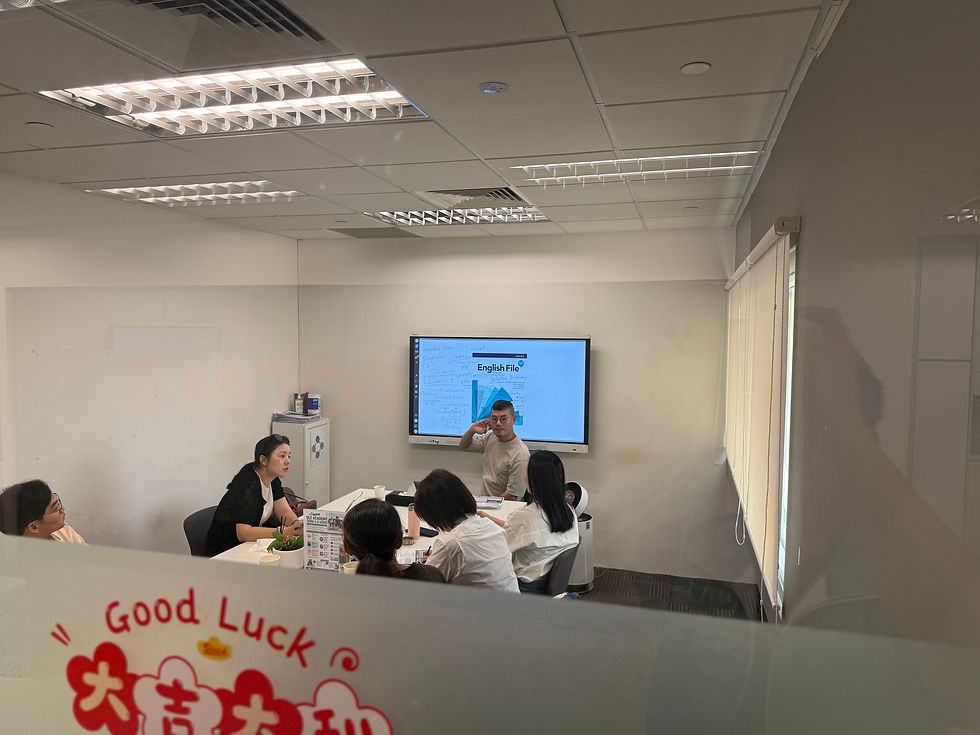
At ULC Academy, adult English classes are small-group classes of four to eight students at our Orchard campus, 111 Somerset Road, #12-22 TripleOne Somerset. The focus is speaking: practical situations you actually face in Singapore — introducing yourself, taking part in a meeting, making a phone call, small talk with colleagues, explaining something clearly, and disagreeing politely. You practise in pairs and in the group, and your teacher corrects the mistakes that matter. Adult English classes start from S$20 per hour, and you can try a class first with a free trial lesson. Morning classes run Monday to Friday, 10:00 AM–12:00 PM, and evening classes run 7:00–9:00 PM. On Saturday and Sunday, classes run 10:00 AM–12:00 PM and 3:00–5:00 PM.
Is a small group right for you?
A small-group speaking class suits you if you can read and write a little English but freeze when you need to speak — if you understand more than you can say, rehearse sentences in your head before saying them, or avoid phone calls and conversations in English even though you know the words. But for most adults who have studied English before and still cannot speak it comfortably, the missing piece is not more grammar. It is more speaking, with real people, in a group small enough that your voice is heard every lesson.
How ULC Academy can help
ULC Academy offers adult English small-group classes of 4–8 students at our Orchard campus, 111 Somerset Road, #12-22 TripleOne Somerset, Singapore. Classes start from S$20/hour, with 1-to-1 lessons from S$90/hour if you ever want extra individual support alongside your group.
Find out more about our adult English courses, or WhatsApp us at +65 9660 9969 to book your free trial class.
ULC Academy is rated 4.9/5 on Google.


Comments