Know English Grammar but Still Make Mistakes When Speaking? 10 Common Errors and How to Fix Them


You know the grammar rules. You can answer English test questions. But when you start speaking, even simple sentences come out wrong. Discover 10 common spoken English grammar mistakes, why they happen, and how to improve your accuracy and confidence.
Have you ever studied English for years, only to make a basic grammar mistake the moment you start speaking?
Perhaps you have completed countless grammar exercises, memorised irregular verbs, and prepared for examinations such as IELTS, TOEFL, or TOEIC.
You understand the difference between the present and past tense.
You know that third-person singular verbs usually need an -s.
You have studied articles, prepositions, and sentence structures.
Yet when someone asks you a question in English, you might say:
❌ Yesterday I go shopping.
Even though you know the past tense of go is went.
Or:
❌ She work in Singapore.
Even though you know the correct form is works.
You might also say:
❌ I very like Singapore.
Because you are translating directly from your first language.
Why does this happen?
Does it mean your English foundation is weak?
Do you need to study more grammar textbooks?
Or is learning English simply more difficult as an adult?
Not necessarily.
Knowing an English grammar rule and using it accurately during a real conversation are two different skills.
When completing a grammar exercise, you usually have time to read the sentence, consider the rules, and select an answer.
During a real conversation, however, you must listen, understand, organise your thoughts, choose vocabulary, apply grammar, and respond—often within seconds.
Even learners with strong grammar knowledge can make mistakes when speaking under these conditions.
The good news is that spoken grammar accuracy can be developed through focused practice.
In this guide, we will explore 10 common English grammar mistakes adults make when speaking, explain why they happen, and introduce practical exercises to help you communicate more naturally.
Whether you are working in Singapore, preparing to move abroad, attending international business meetings, or simply trying to become more confident in everyday English conversations, these techniques can help you make better use of the grammar you already know.
1. Why Do You Make Grammar Mistakes When You Already Know the Rules?
Before looking at individual mistakes, it is important to understand a key difference:
Grammar knowledge is not the same as automatic grammar use.
You may know that:
Past events usually require past-tense verbs.
Third-person singular subjects take specific verb forms in the simple present.
Singular countable nouns generally need an article or another determiner.
English questions often require auxiliary verbs.
Prepositions follow particular patterns.
However, knowing these rules does not guarantee that you will use them correctly in spontaneous conversation.
1.1 Grammar Tests and Real Conversations Require Different Skills
Consider this grammar question:
She ______ in Singapore.
A. work
B. works
C. working
D. worked
If the sentence describes her current employment, the correct answer is:
She works in Singapore.
You may answer this question immediately.
But imagine a colleague suddenly asks:
“What does your wife do?”
You might respond:
“She work in a bank.”
The problem may not be a lack of grammar knowledge.
Instead, you may need more practice retrieving and using the correct structure while speaking.
1.2 Your First Language Can Influence Your English
Every language has its own grammatical structures.
For example, some languages do not use articles in the same way as English.
Others express time primarily through context or separate time expressions rather than changing verb forms.
As a result, learners may transfer patterns from their first language into English.
For example:
❌ I am teacher.
✅ I am a teacher.
Or:
❌ I very like this city.
✅ I really like this city.
These errors often happen because the learner is constructing an English sentence using familiar patterns from another language.
1.3 Speaking Requires Several Skills at Once
Imagine participating in an international business meeting.
You want to explain:
“The client changed the requirements yesterday, so we need more time.”
You are concentrating on the message, the vocabulary, and the reaction of your colleagues.
While doing so, you might forget to use the correct past tense.
This is one reason why grammar accuracy sometimes decreases during spontaneous speech.
The solution is not to stop after every word and check your grammar.
Instead, you need to practise common structures until they become easier to use in real conversations.
2. Mistake 1: Using the Present Tense for Past Events
Common mistake
❌ Yesterday I go shopping.
Correct expression
✅ Yesterday I went shopping.
Why Does This Happen?
English frequently uses changes in verb forms to indicate when an action happened.
Compare:
I go shopping every weekend.
This describes a regular activity.
I went shopping yesterday.
This describes a past event.
I will go shopping tomorrow.
This describes a future plan.
When speaking quickly, learners sometimes focus on the time expression yesterday and forget to change the verb.
More Practical Examples
I met my friend yesterday.
We had a meeting this morning.
I visited Sentosa last weekend.
She called me two hours ago.
I bought groceries after work.
These are common sentences you might use when talking about your day.
How to Practise
Every evening, describe three things you did that day.
For example:
I woke up at seven.
I had lunch with my colleagues.
I finished my work at six.
Focus on using the correct past-tense verbs.
Start with frequently used irregular verbs:
Base Form | Past Tense |
go | went |
have | had |
meet | met |
buy | bought |
see | saw |
take | took |
make | made |
come | came |
Practice tip: Instead of memorising isolated verb lists, use each verb in a sentence about your own life.
3. Mistake 2: Forgetting the Third-Person Singular -s
Common mistake
❌ She work in Singapore.
Correct expression
✅ She works in Singapore.
Why Does This Happen?
In the simple present tense, verbs generally take -s or -es when the subject is he, she, it, or another third-person singular noun.
For example:
I work in Singapore.
You work in Singapore.
They work in Singapore.
But:
She works in Singapore.
He works in Singapore.
Although the rule is straightforward, it is easy to forget during spontaneous speech.
Practical Examples
My husband works in finance.
My daughter studies at an international school.
He speaks English very well.
The shop opens at ten.
My manager travels frequently.
How to Practise
Take one verb and change the subject.
I work.
You work.
We work.
They work.
He works.
She works.
My manager works.
Then expand the sentences:
My manager works in Singapore and travels frequently for business.
My daughter studies at an international school and enjoys reading.
This exercise helps you practise subject–verb agreement while developing your sentence-building skills.
4. Mistake 3: Forgetting Auxiliary Verbs in Questions
Common mistake
❌ You like coffee?
Standard question form
✅ Do you like coffee?
It is worth noting that “You like coffee?” can occur naturally in informal speech, particularly when confirming information or expressing surprise.
However, learners should first become comfortable with the standard question structure.
Why Does This Happen?
In the simple present tense, ordinary English questions generally use do or does.
For example:
Do you like coffee?
Do you work in Singapore?
Does she speak English?
Does your child study here?
Useful Questions for Work
Do you have time this afternoon?
Do you need any help?
Does the meeting start at three?
Do you agree with this proposal?
Does your company provide training?
These questions are useful in both professional and everyday situations.
How to Practise
Start with a statement:
You work in Singapore.
Change it into a question:
Do you work in Singapore?
Now try:
She works in Singapore.
The question becomes:
Does she work in Singapore?
Notice that the main verb returns to its base form after does.
Therefore:
Does she work...?
is correct.
Does she works...?
is incorrect.
5. Mistake 4: Using the Wrong Preposition
Common mistake
❌ I am good in English.
More natural expression when describing ability
✅ I am good at English.
The phrase good in is not incorrect in every context. However, good at is the usual choice when describing a skill or ability.
Why Does This Happen?
English prepositions do not always translate directly into other languages.
Many expressions use particular prepositions that must be learned together with the words around them.
For example:
good at English
interested in English
wait for someone
listen to someone
depend on something
Common Preposition Patterns
Expression | Meaning |
good at | Skilled in something |
interested in | Curious about something |
listen to | Pay attention to sounds or speech |
wait for | Remain until someone or something arrives |
depend on | Be determined by something |
responsible for | Have responsibility for something |
arrive at | Reach a particular place |
arrive in | Reach a city or country |
Practical Examples
I'm interested in learning English.
I'm responsible for this project.
It depends on the schedule.
We arrived in Singapore yesterday.
I'm looking forward to meeting you.
How to Practise
Learn prepositions as part of complete expressions.
Instead of memorising only:
interested
Learn:
be interested in something
Then create a sentence:
I'm interested in improving my business English.
This approach can help you use prepositions more naturally during conversations.
6. Mistake 5: Forgetting Articles: A, An, and The
Common mistake
❌ I am teacher.
Correct expression
✅ I am a teacher.
Why Does This Happen?
Many languages do not use articles in exactly the same way as English.
In English, singular countable nouns generally require an article or another determiner.
For example:
I am a teacher.
She is a doctor.
He works for a company in Singapore.
Understanding A, An, and The
A / An
These articles are often used when introducing a singular countable noun that is not specifically identified.
I bought a book.
She is an engineer.
We visited a museum yesterday.
The
This article is often used when the speaker and listener can identify the particular person or thing being discussed.
The book is on the table.
The meeting starts at nine.
I need to speak to the manager.
Practical Examples
I have a meeting this afternoon.
My son goes to an international school.
We rented an apartment near Orchard Road.
The teacher explained the assignment.
How to Practise
Describe your job, family, and daily routine.
For example:
I'm a business owner.
My wife is a teacher.
I have a daughter.
My daughter studies at an international school.
Whenever you use a singular countable noun, check whether it needs an article or another determiner.
7. Mistake 6: Adding -s to Uncountable Nouns
Common mistake
❌ I need some informations.
Correct expression
✅ I need some information.
Why Does This Happen?
English distinguishes between countable and uncountable nouns.
Some nouns are generally uncountable in everyday English.
Common examples include:
information
advice
equipment
furniture
homework
These nouns do not normally take a plural -s in their usual meanings.
Practical Examples
Could you give me some information about the course?
I need some advice.
We bought some new equipment.
I have a lot of homework today.
The office needs new furniture.
How Do You Express Quantity?
You can use expressions such as:
a piece of advice
three pieces of advice
For example:
Could you give me a piece of advice?
She gave me some useful advice.
Similarly, you can say:
a piece of information
two pieces of information
How to Practise
Learn these nouns through complete sentences.
I need more information.
Could you give me some advice?
We need new equipment.
This helps you remember how the nouns are used in real communication.
8. Mistake 7: Using the Wrong Verb Pattern
Common mistake
❌ I enjoy to swim.
Correct expression
✅ I enjoy swimming.
Why Does This Happen?
Different English verbs are followed by different grammatical structures.
Some verbs commonly take:
to + base verb
Others commonly take:
verb + -ing
For example:
want to learn
decide to leave
enjoy learning
avoid making mistakes
Common Verb Patterns
Verb | Common Pattern |
enjoy | enjoy doing |
avoid | avoid doing |
finish | finish doing |
suggest | suggest doing |
want | want to do |
decide | decide to do |
hope | hope to do |
plan | plan to do |
Practical Examples
I enjoy learning English.
She avoids speaking English in meetings.
I want to improve my pronunciation.
We decided to change the schedule.
I plan to attend an English class next month.
How to Practise
When learning a verb, memorise its common sentence pattern rather than only its meaning.
For example:
Instead of learning:
enjoy = like something
Learn:
enjoy doing something
Then practise:
I enjoy reading.
I enjoy travelling.
I enjoy meeting new people.
I enjoy learning English with my classmates.
9. Mistake 8: Confusing Adjectives and Adverbs
Common mistake
❌ She speaks English good.
Correct expression
✅ She speaks English well.
Why Does This Happen?
English adjectives and adverbs have different functions.
Good is generally an adjective.
Well, in this example, is an adverb describing how someone speaks.
Compare:
She is a good teacher.
She teaches well.
He is a good speaker.
He speaks well.
Practical Examples
She speaks clearly.
He drives carefully.
They work efficiently.
Please speak slowly.
She answered the question confidently.
How to Practise
Ask yourself:
How does she speak English?
Then practise different answers:
She speaks English well.
She speaks English clearly.
She speaks English confidently.
You can also try:
How does he work?
He works efficiently.
How does she explain things?
She explains things clearly.
This helps you become more comfortable using adverbs to describe actions.
10. Mistake 9: Translating Directly from Your First Language
Common mistake
❌ I very like Singapore.
Correct expression
✅ I really like Singapore.
Why Does This Happen?
Different languages use different word orders and expressions.
In English, very is not normally placed directly before the ordinary verb like.
More natural alternatives include:
I really like Singapore.
I like Singapore very much.
Other Common Translation-Related Mistakes
Example 1: Bored or Boring?
❌ I am very boring.
If you mean that you feel bored, say:
✅ I am very bored.
Boring describes something that causes boredom.
Bored describes someone experiencing boredom.
For example:
The movie is boring.
I'm bored.
Example 2: Talking About Age
❌ I have 30 years old.
Correct:
✅ I am 30 years old.
Example 3: Describing English Improvement
I want to improve my English level.
This sentence is not necessarily grammatically incorrect, but in many everyday contexts, the following expressions sound more natural:
I want to improve my English.
Or:
I want to improve my English proficiency.
Example 4: Turning on the Lights
❌ Please open the light.
Correct:
✅ Please turn on the light.
How to Reduce Direct Translation
Learn common English word combinations, also known as collocations.
For example:
make a decision
take a break
turn on the light
pay attention to
have a meeting
make an appointment
take responsibility
Learning these expressions as complete units can help reduce unnatural word-for-word translation.
11. Mistake 10: Confusing the Past Simple and Present Perfect
Common mistake
❌ I live here since 2020.
Correct expression
✅ I have lived here since 2020.
Why Does This Happen?
The past simple and present perfect are often confusing for adult English learners.
The past simple generally describes completed events in the past.
For example:
I moved to Singapore in 2020.
The present perfect can describe a situation that began in the past and continues into the present.
For example:
I have lived in Singapore since 2020.
This means you started living in Singapore in 2020 and still live there.
Since vs For
Since + Starting Point
I have worked here since 2021.
For + Duration
I have worked here for five years.
Practical Examples
I have studied English for three years.
She has lived in Singapore since 2019.
We have known each other for a long time.
I have worked at this company for two years.
How to Practise
Compare these questions.
When did you move to Singapore?
Answer:
I moved to Singapore in 2020.
Now compare:
How long have you lived in Singapore?
Answer:
I have lived in Singapore since 2020.
Practising these question-and-answer patterns can help you understand when to use each tense.
12. Five Practical Ways to Reduce Grammar Mistakes When Speaking English
Understanding common mistakes is only the first step.
The next challenge is learning to use correct grammar more consistently during real conversations.
Here are five practical methods.
Method 1: Focus on One Grammar Point at a Time
Do not try to correct every grammar mistake in a single day.
Instead, choose one specific area.
For example:
Monday: Past tense
Tuesday: Third-person singular
Wednesday: Question forms
Thursday: Articles
Friday: Prepositions
Focusing on one area makes your practice more manageable.
Method 2: Practise Grammar Through Real-Life Sentences
Do not only memorise rules such as:
“He / She / It + verb-s”
Instead, practise:
My husband works in Singapore.
My daughter studies at an international school.
My manager travels frequently.
When you connect grammar with your own life, the structures become more meaningful and easier to practise.
Method 3: Record Yourself Speaking
Choose a simple topic:
My Daily Routine
My Weekend
My Job
My Life in Singapore
Speak for one minute and record yourself.
Then listen to the recording.
Check for common mistakes:
Did you forget the past tense?
Did you omit an article?
Did you use the correct subject–verb agreement?
Did you translate directly from your first language?
Start by correcting just one or two recurring errors.
Method 4: Get Feedback from a Teacher
Some grammar mistakes are difficult to notice without feedback.
For example, if you repeatedly say:
“She work in a bank.”
You may become accustomed to the incorrect form.
A teacher can help identify the mistake, explain the correct structure, and provide targeted speaking practice.
Useful feedback should do more than identify errors.
It should help you use the correct expression more naturally in future conversations.
Method 5: Repeat Correct Structures in Different Situations
Grammar is most useful when it supports communication.
For example, if you are practising:
“I'd like to...”
Use it in different situations:
I'd like to order a coffee.
I'd like to make an appointment.
I'd like to ask about the course.
I'd like to change my booking.
Repeating the same structure in different contexts helps you become more familiar with it.
13. A 15-Minute Daily Routine to Improve Spoken English Grammar
You do not need to spend hours studying grammar every day to begin developing better habits.
A focused 15-minute routine can be a useful starting point.
Minutes 1–3: Review One Grammar Point
For example, practise the past tense.
go → went
have → had
meet → met
buy → bought
Minutes 4–6: Say Five Correct Sentences
I went to work yesterday.
I had lunch with my colleague.
I met a new client.
I bought some groceries.
I finished my report.
Minutes 7–10: Answer Real Questions
Practise answering:
What did you do yesterday?
Where did you go last weekend?
Who did you meet this morning?
Try to answer in complete sentences.
Minutes 11–13: Practise a Real-Life Conversation
Imagine your colleague asks about yesterday's work.
You could say:
“I had two meetings yesterday, and I finished the report in the afternoon.”
Minutes 14–15: Review Your Mistakes
Write down one error you made.
Incorrect:
Yesterday I go shopping.
Correct:
Yesterday I went shopping.
Practise the correct version again the following day.
Weekly Practice Schedule
Day | Grammar Focus |
Monday | Past simple |
Tuesday | Third-person singular |
Wednesday | Question forms |
Thursday | Articles and countable nouns |
Friday | Prepositions and verb patterns |
Saturday | Present perfect |
Sunday | Speaking review and mixed practice |
The purpose of this routine is not to make you analyse grammar every time you speak.
It is to help you become increasingly comfortable using accurate structures in real communication.
14. Why Spoken English Grammar Matters in Singapore
Singapore is a multicultural, international city where English is widely used in business, education, public services, and everyday communication.
For adults living in Singapore, English is more than an academic subject.
It is a practical communication tool.
You may need English when:
Explaining project updates to international colleagues
Speaking with teachers at your child's international school
Describing symptoms during a medical appointment
Asking questions at a bank
Communicating with landlords or property agents
Attending business meetings
Making appointments or enquiries
Building relationships with people from different countries
In these situations, grammar can affect how clearly your message is understood.
Example 1: Describing Work Progress
“I finished the report.”
The report is complete.
“I will finish the report.”
The report will be completed in the future.
These statements communicate different timelines.
Example 2: Describing Employment
“I work in Singapore.”
This describes your current employment.
“I worked in Singapore.”
This describes employment in the past.
The verb form changes how the listener understands your situation.
Example 3: Confirming an Action
“I have sent the email.”
The email has already been sent.
“I will send the email.”
The email will be sent later.
In professional communication, these distinctions can be particularly important.
Improving spoken English grammar is therefore not only about avoiding mistakes.
It is also about communicating information more accurately, clearly, and professionally.
15. Improve Your Spoken English with ULC Academy in Singapore
Have you studied English for years but still struggle with the following problems?
You understand grammar exercises but make mistakes when speaking.
You frequently confuse English tenses.
You forget third-person singular verb endings.
You find articles and prepositions difficult.
You translate directly from your first language.
You hesitate to speak because you are worried about grammar mistakes.
You live in Singapore but have limited opportunities for structured English practice.
You want to improve your everyday or business English communication.
If these situations sound familiar, you may benefit from more opportunities to practise the grammar you already know.
ULC Academy, located in Singapore's Somerset / Orchard area, provides English courses for adult learners at different proficiency levels.
Our programmes combine speaking, listening, pronunciation, vocabulary, and grammar practice with classroom interaction.
The goal is to help learners apply their English knowledge in practical communication situations.
15.1 English Courses Based on CEFR Levels
ULC Academy offers adult English courses across different proficiency levels.
These include:
A1 Beginner
A2 Elementary
A2+ Pre-Intermediate
B1 Intermediate
B1+ Intermediate Plus
B2 Upper-Intermediate
C1 Advanced
C1+ Advanced Plus
Students can complete an English level assessment to help identify a suitable starting point.
Even if you already understand English grammar, your actual speaking and listening abilities should be considered when selecting a course.
15.2 Oxford English File Fifth Edition
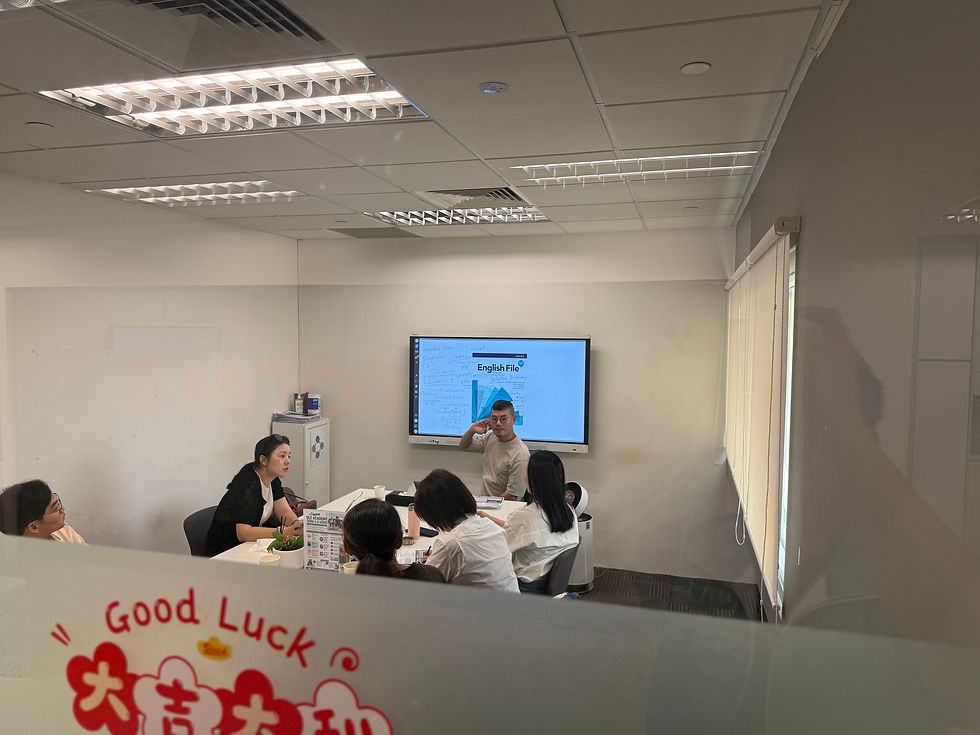
ULC Academy uses the Oxford English File Fifth Edition series in its adult English programme.
The curriculum includes:
English speaking and conversation
Listening comprehension
Pronunciation
Practical vocabulary and sentence patterns
English grammar
Everyday communication
Business English
Classroom discussions and interactive activities
By combining grammar learning with practical speaking activities, students have opportunities to develop greater accuracy and fluency.
15.3 Small-Group English Classes
ULC Academy offers small-group English classes for adults.
Group lessons are generally two hours per session. Actual class sizes and schedules depend on the available classes.
Students can practise English with teachers and classmates from different backgrounds.
Classroom activities may include:
Question-and-answer practice
Group discussions
Role-playing
Everyday conversation exercises
Grammar practice in context
Listening and speaking activities
Small-group classes may be particularly suitable for adults who have studied English before but need more opportunities to speak.
15.4 One-to-One Private English Lessons
For learners who prefer personalised instruction, ULC Academy also offers one-to-one English lessons.
Areas of focus may include:
Spoken English grammar correction
English tense practice
Sentence-building skills
Business English communication
Meetings and presentations
Everyday conversation
Pronunciation
English interview preparation
Lesson content can be discussed according to the student's current level and learning goals.
15.5 Who Can Join?
ULC Academy's adult English courses may be suitable for:
Working professionals in Singapore
International employees and expatriates
Business owners and entrepreneurs
Parents of international school students
Adults preparing to relocate to Singapore
Learners returning to English study
Mature adults and senior learners
Anyone who wants to improve everyday English communication
15.6 Free English Level Assessment and Trial Class
Not sure about your current English level?
Unsure whether a small-group class or private lesson would suit you better?
ULC Academy offers a free English level assessment and trial class for its general adult English programme.
You can experience the classroom environment, discuss your learning challenges, and explore suitable course options.
Contact ULC Academy
School: ULC Academy
Address:
111 Somerset Road, #12-22 Tripleone Somerset, Emerald Hill, Singapore, Singapore, 238164
Location: Somerset / Orchard, Singapore
Website:

Adult English Courses:

Email:
Contact ULC Academy to enquire about current class schedules, course fees, and free trial availability.
16. Frequently Asked Questions (FAQ)
Q1. Why do I make grammar mistakes when speaking English even though I know the rules?
Knowing grammar rules and using them during spontaneous speech require different skills. Speaking practice, repetition, and feedback can help you apply familiar structures more consistently.
Q2. Do frequent grammar mistakes mean my English foundation is weak?
Not necessarily. Even learners with substantial grammar knowledge can make mistakes when speaking quickly, especially if they have limited opportunities for conversation practice.
Q3. Should adults study grammar first or practise speaking first?
Grammar study and speaking practice can be combined. After learning a rule, use it to create sentences, answer questions, and practise real conversations.
Q4. What are the most common spoken English grammar mistakes?
Common mistakes include incorrect tenses, subject–verb disagreement, question formation errors, incorrect prepositions, missing articles, uncountable noun errors, incorrect verb patterns, and direct translation.
Q5. How can I stop making English tense mistakes?
Start with frequently used verbs and common tenses. Practise describing past experiences, current activities, and future plans using complete sentences.
Q6. Is 15 minutes of English practice a day enough?
Fifteen minutes can be a useful starting point for developing a consistent practice habit. Results depend on your current level, practice quality, consistency, and feedback.
Q7. Can adults over 40, 50, or 60 improve their English grammar and speaking?
Yes. Adults can continue developing language skills through suitable learning methods, consistent practice, and appropriate feedback.
Q8. Will living in Singapore automatically improve my English grammar?
Not necessarily. Living in an English-speaking environment provides opportunities to use the language, but active practice and feedback are still important.
Q9. Can small-group English classes help correct grammar mistakes?
Small-group classes provide opportunities for interaction and speaking practice. When combined with grammar instruction and feedback, they can help learners recognise and improve recurring errors.
Q10. Does ULC Academy offer free English trial lessons?
Yes. ULC Academy offers free English level assessments and trial classes for its general adult English programme. Contact the school for available arrangements.
Conclusion: The Real Purpose of English Grammar Is Better Communication
Many adults have spent years studying English.
They have memorised vocabulary, completed grammar exercises, and prepared for examinations.
Yet they may still make simple mistakes when speaking.
This does not mean their previous efforts were wasted.
The grammar knowledge they already have can provide a valuable foundation for improving their spoken English.
The next step is to turn that knowledge into practical communication skills.
Start by identifying your most common grammar mistakes.
Focus on one grammar point at a time.
Practise using grammar in complete sentences.
Repeat useful structures through questions, role-playing, and real conversations.
Record your mistakes and try to correct them the next time you speak.
You do not need to speak perfect English from the beginning.
What matters is gradually improving your accuracy and fluency while continuing to communicate your ideas.
The ultimate purpose of learning English grammar is not simply to answer examination questions correctly. It is to help you express your thoughts more clearly, naturally, and confidently when English communication matters.
If you are looking for structured adult English speaking practice in Singapore, explore ULC Academy's small-group classes and one-to-one lessons.
With an English level assessment, interactive lessons, and practical speaking activities, you can find a learning approach that suits your goals.
ULC Academy — Learn with Purpose. Speak with Confidence.
Explore our adult English courses and book a free trial:


Comments