Job Interview English: How to Answer Common Questions with Confidence


A job interview in English is stressful enough without worrying about your grammar. For many professionals in Singapore, the interview is not really a test of your professional ability — it is a test of whether you can explain that ability clearly, under pressure. The good news is that interview English is a learnable skill: the questions are predictable and the answers can be prepared.
"Tell Me About Yourself"
This is almost always the first question, and it sets the tone for the whole interview. The mistake many candidates make is listing their whole CV. The interviewer already has your CV — they want a short, focused story.
Use a simple three-part structure: present, past, future — your current role, one or two relevant experiences that led you here, and why this job is the natural next step.
For example: "I'm a project coordinator at a logistics company in Singapore, where I manage schedules and communicate with clients across Asia. Before that, I worked in customer service, which taught me how to handle difficult conversations calmly. I'm now looking for a role where I can use both my coordination experience and my communication skills."
Aim for 60 to 90 seconds.
Talking About Your Strengths
Choose two or three strengths that match the job description, and support each with a brief example — a strength without evidence is just a claim. For instance: "One of my strengths is problem-solving. For example, when our team faced a delivery delay, I..." — strength, then a short real example, then the result. Interviewers remember stories far better than adjectives.
Rehearse your workplace English examples in advance until the key phrases feel natural, so you can focus on the content, not on searching for words.
Talking About Your Weaknesses Honestly
This question worries many candidates, but the interviewer is not looking for perfection — they want self-awareness and a willingness to improve.
Pick a real, minor weakness — not a disguised strength like "I work too hard" — and explain what you are doing about it. For example: "I used to hesitate to speak up in large meetings. To improve, I joined a small speaking group and practise presenting every week."
This works because it is honest, specific, and shows action. Avoid mentioning weaknesses central to the job — if you are applying for a sales role, do not say you dislike talking to people.
"Why Should We Hire You?" and "Why Do You Want This Job?"
Both questions really ask the same thing: what can you offer us, and why us? For "Why should we hire you?", connect your experience directly to the job's needs: "You mentioned that this role needs someone who can work with clients across different countries. In my current job, I do exactly that every day..." For "Why do you want this job?", show that you have researched the company. Mention something specific — a product, a value, a recent project — and link it to your own goals: "I've followed your company's work in sustainable packaging, and I'm excited by the chance to contribute to a team that..." Generic answers like "It's a great company" tell the interviewer nothing. One specific detail shows you prepared.
Questions About Salary Expectations
Salary questions make many candidates uncomfortable, but a calm, prepared answer is part of good English for working adults in Singapore. If asked early, it is fine to stay flexible: "I'd like to learn more about the full role and benefits before discussing a specific number. Could you share the range you have in mind for this position?" If pressed, give a range based on market research, not a single number: "Based on my experience and the market rate for this role in Singapore, I'd be looking at something in the range of..."
Questions to Ask the Interviewer
An interview is a two-way conversation. When the interviewer asks, "Do you have any questions for us?", always have two or three ready. Saying "No, that's all" can make you look uninterested. Good questions include: "What does success look like in this role in the first six months?", "How does the team usually work together on projects?", and "What opportunities are there for learning and development?" These show curiosity and a serious attitude.
How to Practise
Reading about interview English is not enough — you need to say the answers out loud. Three methods work well:
1. Mock interviews. Ask a friend to interview you with real questions and give honest feedback. Record yourself and listen back for filler words and rushed answers.
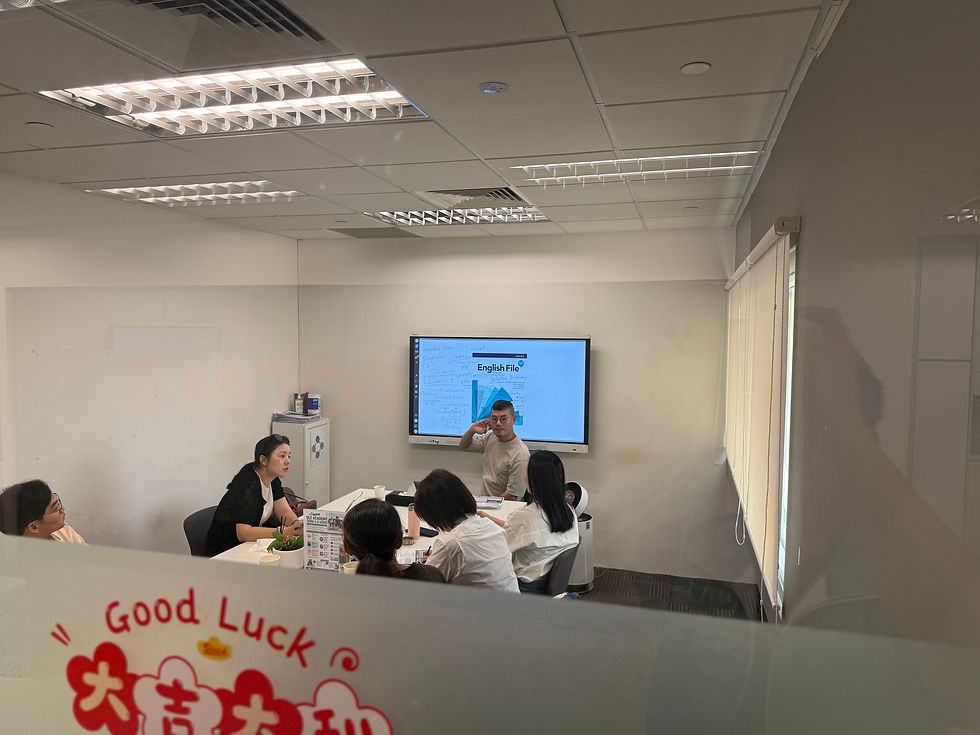
2. Small-group speaking practice. Practising alone helps, but interviews are interactive. In a small group, you learn to listen, respond naturally, and handle follow-up questions — the moments that cannot be scripted. Learning how to present with confidence uses many of the same skills: clear structure, steady pace, and calm delivery under pressure.
3. Daily short practice. Ten minutes a day beats a single long session. Pick one question each day, prepare a 60-second answer, and say it aloud three times. Over a month, you will have prepared answers for every common question.
Your Next Step
Interview English is not about perfect grammar. It is about clear, confident answers that show the interviewer who you are and what you can do. Prepare your stories, practise them out loud, and walk in knowing you have done the work.
If you would like structured help, ULC Academy offers adult English classes in small groups of 4–8 students, plus 1-to-1 lessons, with bilingual teachers who can explain in your own language when you need it. Business English starts from S$20 per hour, and you can try a free trial class first. Classes run Monday to Friday, 10:00 AM–12:00 PM and 7:00–9:00 PM, and Saturday to Sunday, 10:00 AM–12:00 PM and 3:00–5:00 PM, at 111 Somerset Road, #12-22 TripleOne Somerset, Singapore 238164.
Find out more about our adult English courses at ULC Academy's adult English page, or message us on WhatsApp at

to book your free trial class.


Comments