Group English Classes vs Private English Lessons in Singapore: Which Is Better for Adults? A Complete Guide to Costs, Benefits and Learning Outcomes

Choosing the Right English Course for Your Level, Goals, Budget and Lifestyle
Should you choose group English classes or private one-to-one English lessons in Singapore?
This is one of the most common questions adults ask when looking for an English course.
Whether you are an expatriate who has recently moved to Singapore, a working professional, an international parent, or someone hoping to improve everyday English communication, choosing the right learning format can make a meaningful difference to your learning experience.
Some learners believe:
"Private English lessons must help me improve faster."
Others think:
"Group English classes give me more opportunities to communicate with different people."
So which option is actually better?
The answer is that neither group classes nor private lessons are automatically better for everyone. The best choice depends on your current English level, learning objectives, budget, schedule and preferred learning environment.
For example:
If you want to meet new people and practise everyday English conversations, group lessons may be a good choice.
If you are preparing for an important job interview, private lessons may offer more targeted preparation.
If you have limited English proficiency and want to build your vocabulary, grammar, listening and speaking skills systematically, a suitable level-based group course may provide helpful structure.
If you are a business professional who needs to improve presentations, meetings or negotiations, private lessons may allow the teacher to focus on your specific workplace situations.
If you have recently relocated to Singapore, practical communication exercises can help you prepare for everyday interactions.
In this guide, we compare group English classes and private English lessons in Singapore, including their advantages, limitations, costs, suitable CEFR levels and recommended learning approaches.
By the end, you should have a clearer understanding of which learning format may suit your needs.
1. What Are Group English Classes for Adults?
Group English classes involve several learners studying together under the guidance of one teacher.
Students are typically placed into classes according to their English proficiency, with lessons following a structured curriculum.
Common learning activities include:
English vocabulary and grammar
Everyday conversation
Listening comprehension
Pronunciation and speaking
Reading and writing
Role-playing activities
Group discussions
Interactive communication exercises
For adults who want to develop their English skills over time, group classes can provide a structured and consistent learning environment.
1.1 Advantages of Group English Classes
Advantage 1: Opportunities to Communicate with Different People
Learning English requires more than listening to explanations.
Students also need opportunities to use the language.
In group classes, learners can interact with their teacher and other classmates.
For example, a teacher might ask:
"What do you usually do on weekends?"
Students can describe their weekend activities and ask follow-up questions.
This helps learners practise speaking while becoming more familiar with different voices and communication styles.
Advantage 2: A Learning Environment That Resembles Real Social Situations
In everyday life, people rarely communicate with only one person.
For example:
Participating in workplace meetings
Having dinner with friends
Attending social gatherings
Speaking with other parents at school
Joining community activities in Singapore
Group lessons provide opportunities to practise listening, asking questions, responding and participating in conversations involving multiple people.
Advantage 3: Generally More Affordable
Because several learners share the teaching time, group English classes typically cost less per hour than private lessons.
For adults planning to study English over several months, affordability can be an important consideration.
Advantage 4: A Consistent Learning Routine
Fixed class schedules can help learners establish regular study habits.
Interacting with classmates may also provide motivation to continue learning.
For busy adults who struggle to maintain a self-study routine, scheduled lessons can offer useful structure.
1.2 Limitations of Group English Classes
Group classes are not ideal for every learner.
Potential limitations include:
Teachers must divide their attention among several students.
Lessons generally follow a shared curriculum.
Individual questions may receive less dedicated time.
Class schedules are often fixed.
Significant differences in student proficiency can affect the learning experience.
Therefore, the quality of a group English class depends on more than its size. Appropriate level placement, effective classroom interaction and clear learning objectives are equally important.
2. What Are Private One-to-One English Lessons?
Private English lessons involve one teacher working directly with one student.
The lesson content, teaching pace and learning activities can be adapted to the student's individual needs.
For example, imagine a business manager working in Singapore who already has B2-level English proficiency but lacks confidence during negotiations.
This learner may not need to study basic grammar again.
Instead, the priority might be learning how to:
Explain business opinions clearly
Respond to client objections
Lead meetings in English
Participate in negotiations
Use accurate professional vocabulary
Answer unexpected questions confidently
These objectives may benefit from personalised instruction.
2.1 Advantages of Private English Lessons
Advantage 1: Personalised Learning Content
A teacher can adapt lessons to a student's English level, professional background and learning goals.
For example:
A healthcare professional may need to practise communicating with patients.
A business executive may want to improve presentations.
An international parent may need practical English for shopping, medical appointments and communication with schools.
Different goals can be addressed through different lesson plans.
Advantage 2: Focused Attention on Individual Weaknesses
Some learners experience specific difficulties, such as:
Inaccurate pronunciation
Repeated grammar mistakes
Difficulty understanding natural speaking speeds
Long pauses when speaking
Limited business vocabulary
Lack of confidence in meetings
Private lessons allow teachers to spend more time analysing and practising these areas.
Advantage 3: Training for Real-Life Requirements
Suppose you have a job interview next week.
Your teacher could help you practise questions such as:
"Tell me about yourself."
"Why are you interested in this position?"
"Can you describe a challenging situation at work?"
If you are preparing for a business meeting, lessons could also include relevant materials and simulated discussions.
Advantage 4: Adjustable Learning Pace
If you already understand a topic, the teacher can move forward.
If you need additional practice, more time can be allocated to that skill.
However, private lessons do not automatically guarantee faster improvement than group classes.
Learning outcomes still depend on teaching quality, study time, practice methods and student engagement.
2.2 Limitations of Private English Lessons
Private lessons also have potential disadvantages:
Hourly fees are usually higher.
Opportunities to interact with other learners are limited.
Lessons may lack structure without clear learning goals.
Some learners may become overly dependent on teacher assistance.
Additional listening practice may be needed to become comfortable with different accents and communication styles.
When choosing private lessons, it is helpful to ask whether the teacher provides a clear learning plan and regular feedback.
3. Group English Classes vs Private English Lessons: Complete Comparison
Comparison | Group English Classes | Private English Lessons |
Learning format | Several students learn together | One teacher works with one student |
Curriculum | Usually follows a level-based programme | Can be adapted to individual goals |
Learning pace | Based on the class programme | Can be adjusted individually |
Speaking practice | Interaction with teachers and classmates | Focused practice with the teacher |
Listening practice | Exposure to different classmates | Targeted listening exercises |
Grammar correction | Teacher supports several learners | More time for individual feedback |
Social interaction | Generally more opportunities | Relatively limited |
Scheduling | Usually fixed | Depends on teacher availability |
Cost | Generally lower | Generally higher |
Suitable goals | Long-term improvement and daily communication | Specific skills and personalised goals |
Learning environment | Collaborative and interactive | Individualised and focused |
Main limitation | Less individual attention | Higher cost and fewer peer interactions |
Key Takeaway
If you want to improve your overall English proficiency through consistent learning and interaction, group classes may be a suitable option.
If you have a specific learning objective and need targeted practice, private lessons may be more appropriate.
If your schedule and budget allow, combining both approaches is another possibility.
4. Which Learning Format Is Best for Your CEFR English Level?
CEFR English Levels: A1, A2, B1, B2 and C1
The Common European Framework of Reference for Languages (CEFR) is widely used to describe language proficiency.
When choosing an English course, adults should consider their current communication abilities rather than relying only on how many years they have studied English.
A1 Beginner: Starting to Learn English
Typical abilities
Understands a limited number of simple English expressions
Has a small vocabulary
Finds everyday conversations difficult
Is unfamiliar with basic grammar structures
Recommended approach
A beginner-level group course can provide a structured introduction to English.
Private lessons may be more suitable if the learner requires a highly individualised pace.
Learning priorities
Basic vocabulary
Common sentence patterns
Numbers and time
Self-introduction
Simple questions
Basic listening comprehension
A2 Elementary: Building Basic Communication Skills
Typical abilities
Can introduce themselves
Understands some everyday questions
Can manage simple shopping or ordering situations
Still struggles with complex conversations
Recommended approach
Group classes can offer useful opportunities to practise everyday communication.
Private lessons may help address specific difficulties with pronunciation or listening.
Learning priorities
Everyday English
Simple conversations
Basic grammar
Listening comprehension
Asking and answering questions
B1 Intermediate: Developing Independent Communication
Typical abilities
Can participate in familiar everyday conversations
Can describe personal and professional experiences
Can express basic opinions
May struggle with fast or complex discussions
Recommended approach
Group classes can support discussion and interactive speaking practice.
Private lessons may be useful for specific workplace communication needs.
Learning priorities
Speaking fluency
Listening comprehension
Group discussions
Expressing opinions
Workplace communication
B2 Upper-Intermediate: Improving Professional Communication
Typical abilities
Can communicate relatively independently
Can discuss more complex topics
Can participate in some English-language meetings
Wants to improve accuracy and professional expression
Recommended approach
Group classes may be suitable for broadening discussion skills.
Private lessons may be more targeted for business negotiations, presentations, interviews and industry-specific communication.
C1 Advanced: Refining English Communication
Typical abilities
Understands complex information
Can express opinions fluently
Can participate in professional discussions
Wants to improve precision, structure and language style
Recommended approach
Advanced discussion-based group classes and specialised private lessons can both be useful.
The main consideration is whether the course offers sufficient challenge and relevance.
5. Ten Common Learning Goals: Which Type of English Class Should You Choose?
Learning Goal | Suggested Option | Why |
1. You recently moved to Singapore and want everyday conversation practice | Group classes | Opportunities to interact with different people |
2. You are a complete beginner | Beginner group or private lessons | Depends on your learning pace |
3. You are preparing for an English job interview | Private lessons | Targeted interview simulations |
4. You want to build speaking confidence | Group classes | Interactive speaking opportunities |
5. You are an executive improving negotiation skills | Private lessons | Customised professional scenarios |
6. You want consistent long-term English improvement | Group classes | Structured and regular learning |
7. You need to improve specific pronunciation problems | Private lessons | Focused individual feedback |
8. You want to understand different English accents | Group classes plus varied listening practice | Exposure to different communication styles |
9. Your work schedule changes frequently | Private lessons | Potentially more flexible scheduling |
10. You want both general English and specialised skills | Group plus private lessons | Different formats serve different objectives |
These recommendations are general guidelines.
Teaching quality, class placement, individual preferences and learning habits should also influence your decision.
6. English Course Fees in Singapore: How Much Do Group and Private Lessons Cost?
For many adults, tuition fees are an important factor when choosing an English course.
However, comparing hourly prices alone does not provide the full picture.
You should also consider:
Total contact hours
Lesson duration
Class size
Teacher experience
Curriculum
Level placement
Learning feedback
Additional fees
Cancellation and make-up lesson policies
Course validity period
Example: ULC Academy Reference Fees
ULC Academy offers adult English courses with the following reference hourly rates:
Lesson Format | Reference Hourly Fee |
Adult group English classes | S$30 |
Private one-to-one English lessons | S$160 |
These are reference rates. Actual fees may vary depending on the course, lesson package, promotions and applicable conditions. Please contact the academy for an official quotation.
Example: Studying Four Hours Per Week
Item | Group Classes | Private Lessons |
Reference hourly fee | S$30 | S$160 |
Weekly study time | 4 hours | 4 hours |
Reference weekly cost | S$120 | S$640 |
Total hours over 4 weeks | 16 hours | 16 hours |
Reference 4-week cost | S$480 | S$2,560 |
This example shows that group classes can be substantially more affordable for the same number of contact hours.
However, it does not mean group classes always produce better outcomes or that private lessons are not worth the additional cost.
The two formats may serve different learning purposes.
Four Questions to Ask Before Comparing Prices
1. Does the course match your goals?
If you mainly want to improve everyday communication, you may not need all your lessons to be private.
If you are preparing for an important presentation, targeted private training may be more relevant.
2. Will you have sufficient opportunities to practise?
English learning requires active listening, speaking, reading and writing—not just watching the teacher explain concepts.
3. Can you sustain the learning plan?
Your schedule and budget should allow you to study consistently.
4. Can you measure your progress?
Consider whether you can:
Understand more everyday conversations
Make appointments over the phone
Participate more actively in meetings
Explain your opinions more clearly
These practical improvements can be more meaningful than comparing hourly fees alone.
7. Why English Learning Is About More Than Classroom Hours
Many adults ask:
"If I study English for four hours every week, how long will it take to become fluent?"
There is no universal answer.
Progress depends on several factors, including:
Your starting English level
Teaching quality
Practice frequency
Revision habits
Opportunities to use English
Clarity of learning goals
Ongoing feedback
For example, imagine two students attending four hours of English lessons each week.
Student A rarely uses English outside class.
Student B attends the same number of lessons, reviews vocabulary for 15 minutes daily and actively uses English while shopping or working.
Their learning experiences and progress may differ.
This does not guarantee a particular result, but it highlights the importance of combining lessons with regular practice.
A Practical Learning Cycle
Classroom Learning
Learn new language concepts and practise with teacher guidance.
Revision
Review vocabulary, grammar and useful expressions.
Real-Life Practice
Use English at work, while shopping and during social activities.
Feedback
Identify improvements and areas that need further attention.
8. Why Group English Classes Can Be Particularly Useful for Expats in Singapore
English Conversation Classes for Expats in Singapore
Singapore is a highly international city where people from different linguistic and cultural backgrounds live and work.
For expatriates and international families, learning English is often about much more than examinations.
It can be essential for everyday communication.
Common situations include:
Ordering food at restaurants
Speaking with doctors
Communicating with landlords
Attending school parent meetings
Chatting with colleagues
Joining community activities
Making friends from different countries
These situations share one important characteristic:
Real-life English communication usually involves interacting with different people, not just one teacher.
Group classes can help learners practise these interactions.
Situation 1: Introducing Yourself
Students can describe their country, occupation, family and interests.
Situation 2: Asking Questions
Instead of only answering the teacher, students practise asking classmates questions.
Situation 3: Understanding Different Speaking Styles
Classmates may have different first languages, accents and communication habits.
This can provide useful linguistic variety.
Situation 4: Participating in Discussions
For example:
"What are the advantages of living in Singapore?"
Students can share opinions and respond to different perspectives.
Situation 5: Practising Everyday Scenarios
Examples include:
Booking a medical appointment
Returning a purchased item
Planning a trip
Arranging a meeting with colleagues
Asking a teacher about a child's progress
These exercises can help connect classroom learning with real communication needs.
However, their effectiveness depends on the course design and quality of classroom interaction.
9. Five Situations Where Private English Lessons May Be More Suitable
Private English Lessons Singapore
Private lessons can be especially useful when your learning objective is clearly defined.
Situation 1: Preparing for an English Job Interview
You can practise questions such as:
"Tell me about yourself."
"What are your strengths?"
"Why should we hire you?"
"Can you describe a difficult situation at work?"
A teacher can provide feedback on your answer structure, vocabulary and clarity.
Situation 2: Preparing for Business Presentations
Examples include:
Annual business reviews
Product launches
Investor presentations
Client proposals
Project updates
Training may focus on:
Presentation structure
Expressing opinions
Logical transitions
Answering questions
Professional vocabulary
Delivery practice
Situation 3: Improving Pronunciation
If certain pronunciation difficulties regularly cause misunderstandings, targeted practice may help.
Examples include:
Confusing English sounds
Word stress
Sentence rhythm
Intonation
Connected speech
Situation 4: Learning Industry-Specific English
Examples include:
Financial English
Medical English
Business English
English for education professionals
Customer service English
Management communication
Private lessons can incorporate materials related to your professional responsibilities.
Situation 5: Managing an Irregular Schedule
Adults who travel frequently or work changing shifts may find private lessons easier to schedule.
However, actual flexibility depends on teacher and academy availability.
10. Can Adults Combine Group Classes and Private English Lessons?
Yes.
Group and private lessons do not always need to be mutually exclusive.
If your schedule and budget allow, combining them can address different learning needs.
Example: A B1-Level Working Professional
Learning goals:
Improve everyday speaking fluency
Understand natural conversations with colleagues
Communicate more confidently in meetings
Reduce recurring grammar mistakes
A possible weekly plan could look like this:
Learning Activity | Weekly Time | Main Objective |
Group English classes | 4 hours | Conversation, listening and interaction |
Private English lessons | 1 hour | Individual weaknesses and workplace scenarios |
Independent revision | Approximately 2 hours | Vocabulary, grammar and listening |
Real-life practice | As opportunities arise | Apply English in everyday situations |
This is only an example.
Not every learner needs to enrol in both formats.
If your budget is limited, you can begin with one type of course and supplement it with independent practice.
The key is to give each learning activity a clear purpose.
11. Ten Things to Check Before Choosing an Adult English School in Singapore
Whether you choose group classes or private lessons, consider asking the following questions before enrolling.
1. Does the school provide an English placement assessment?
Without appropriate placement, students may find lessons too easy or too difficult.
2. How many students are in each group class?
Class size can influence speaking opportunities and teacher attention.
However, lesson structure and teaching quality are also important.
3. Is there a clear curriculum?
Look for:
CEFR levels
Learning objectives
Teaching materials
Lesson content
Progressive learning outcomes
4. Does the course include practical communication?
If your priority is speaking and listening, ask how much time is devoted to interactive practice.
5. Will teachers provide feedback?
Feedback helps learners understand:
What they have mastered
What still needs improvement
Whether their learning approach should change
6. Does the schedule fit your lifestyle?
A course is difficult to maintain if you cannot attend consistently.
7. Are the fees and policies transparent?
Confirm:
Hourly fees
Total lesson hours
Course validity
Absence policies
Make-up lesson arrangements
Refund conditions
Additional charges
8. Can you attend a trial lesson?
A trial lesson can help you evaluate:
Teaching style
Classroom interaction
Course difficulty
Learning atmosphere
Personal suitability
9. Does the course address your actual needs?
If you need business English, choosing a basic course only because it is cheaper may not be appropriate.
Similarly, if your goal is everyday conversation, a highly specialised business programme may not be necessary.
10. Can you commit to learning consistently?
Language development generally requires sustained effort.
Choose a learning environment you can realistically maintain.
12. A Four-Week English Learning Plan for Adults
Whether you choose group classes or private lessons, starting with a simple learning plan can help you establish clear priorities.
The following example is designed for adults who want to improve everyday English communication.
Week 1: Understand Your Current English Level
Main activities:
Complete an English placement assessment
Identify your learning goals
Recognise listening and speaking difficulties
Practise introducing yourself
Record 20 useful everyday English expressions
Week 2: Build Everyday Communication Skills
Main activities:
Practise shopping and ordering food
Review time and date expressions
Learn common questions
Complete simple role-playing activities
Try starting short conversations in English
Week 3: Improve Listening and Speaking
Main activities:
Listen to English at natural speaking speeds
Practise summarising information
Learn polite clarification phrases
Describe personal experiences
Participate in discussions or simulated conversations
Week 4: Evaluate Your Progress
Main activities:
Repeat a simple speaking task
Compare your performance with Week 1
Identify more situations you can handle independently
Record remaining difficulties
Set goals for the following month
How Can You Tell Whether Your English Is Improving?
Do not focus only on how many words you have memorised.
Consider whether:
Everyday questions are easier to understand
You can respond more quickly
You pause less frequently during conversations
You are more willing to speak English
You can handle more everyday situations independently
These changes can provide practical indicators of progress.
13. ULC Academy: Adult Group English Classes and Private Lessons in Singapore
Adult English Classes at ULC Academy Singapore
If you are looking for adult English courses in Singapore, ULC Academy offers learning options for students with different proficiency levels and objectives.
Located in Singapore's Somerset area, ULC Academy provides English language programmes for adults who want to improve their communication skills.
13.1 CEFR-Based English Curriculum
ULC Academy's adult English courses follow a level-based approach aligned with the CEFR framework.
Available levels include:
A1 Beginner
A2 Elementary
A2+ Pre-Intermediate
B1 Intermediate
B1+ Intermediate Plus
B2 Upper-Intermediate
C1 Advanced
C1+ Advanced Plus
This structure helps learners identify courses appropriate for their current abilities and learning goals.
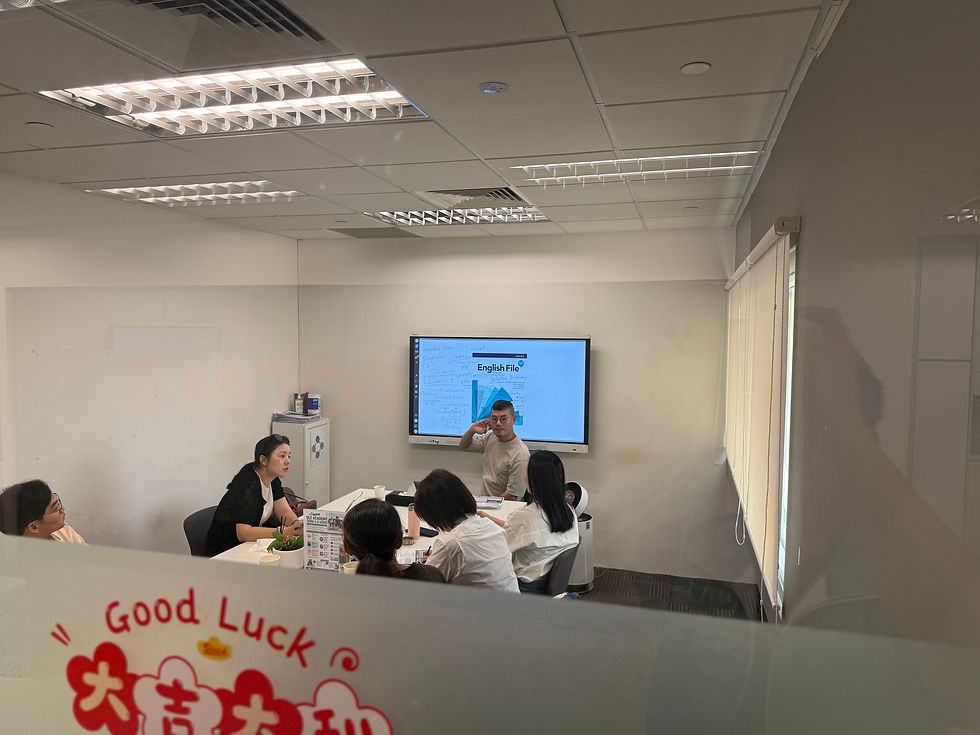
13.2 Small-Group English Classes for Adults
ULC Academy offers small-group English classes.
The average class has approximately five students, with a maximum of ten.
Depending on the class level and programme, lessons may include:
Everyday English conversation
Listening comprehension
English grammar
Practical vocabulary
Reading and writing
Role-playing exercises
Group discussions
Speaking practice
These classes may suit adults who want to develop consistent study habits and improve everyday communication.
13.3 Private One-to-One English Lessons
ULC Academy also provides private English lessons for learners with specific goals.
Examples include:
Everyday speaking improvement
Workplace English
Business communication
English job interviews
Presentations and professional expression
Listening practice
Personalised language development
Lesson content and scheduling can be discussed according to the student's English proficiency, learning objectives and teacher availability.
13.4 Free English Placement Assessment and Trial Lessons
If you are unsure whether group classes or private lessons would suit you better, an English placement assessment can be a useful starting point.
ULC Academy offers free English placement assessments and trial lessons.
These allow prospective students to explore:
Their current English proficiency
The suitability of the lesson level
The teacher's instructional approach
The classroom environment
Which learning format may better match their objectives
13.5 Convenient Somerset Location
ULC Academy
111 Somerset Road, #12-22 Tripleone Somerset, Emerald Hill, Singapore, Singapore, 238164.
Explore our adult English courses:

Contact ULC Academy to enquire about current class schedules, course fees, trial lessons and suitable learning options.
14. Frequently Asked Questions (FAQ)
Q1. Are group English classes or private English lessons better for adults in Singapore?
It depends on your goals. Group classes may be suitable for adults seeking long-term English improvement and opportunities to interact with different people. Private lessons may be more appropriate for learners with specific objectives requiring targeted practice.
Q2. Will private English lessons help me improve faster?
Not necessarily. Progress depends on your current English proficiency, teaching quality, practice frequency, motivation and other factors. Private lessons allow more personalised instruction, but they do not guarantee faster improvement than group classes.
Q3. Can complete beginners join group English classes?
Yes, provided the class is suitable for beginners. Learners who require a highly individualised pace or have particular learning needs may also consider private lessons.
Q4. What is a suitable class size for adult English lessons?
There is no universal ideal class size. It depends on the curriculum, teaching methods and learner needs. At ULC Academy, adult group English classes have approximately five students on average and a maximum of ten.
Q5. How much do adult English lessons cost in Singapore?
Fees vary by school, lesson format, teacher and package. At ULC Academy, reference fees are approximately S$30 per hour for adult group classes and S$160 per hour for private lessons. Actual prices are subject to the academy's official quotation.
Q6. Which option is better for busy working adults?
If you can attend regularly scheduled lessons, group classes can provide a consistent routine. If your work schedule changes frequently, private lessons may offer greater scheduling flexibility, subject to availability.
Q7. Which format is better for improving speaking confidence?
Group classes provide opportunities to communicate with different learners. Private lessons allow focused practice on individual speaking difficulties. The best option is often the environment in which you feel comfortable participating actively.
Q8. Should I choose private lessons for business English?
Private lessons may be useful for job interviews, negotiations, professional presentations and industry-specific communication. However, suitable business English group classes can also help develop general workplace communication skills.
Q9. Can I take group classes and private lessons at the same time?
Yes. If your schedule and budget allow, you can use group classes for structured learning and interaction while using private lessons to address specific weaknesses.
Q10. Does ULC Academy offer free trial English lessons?
Yes. ULC Academy offers free English placement assessments and trial lessons. Prospective learners can explore their current proficiency and available learning options before deciding which format to choose. Contact the academy to confirm trial availability.
Conclusion: The Best English Course Is Not Necessarily the Most Expensive One
When choosing an English course, many adults focus first on tuition fees.
Others assume that private lessons must be more effective because they cost more.
However, there is no simple relationship between the price of a course and the learning results it will produce.
What matters most is:
Your current English level
Your learning objectives
The skills you want to improve
The time you can dedicate to learning
Your budget
Your preference for group interaction
Your need for personalised instruction
Your ability to maintain a consistent learning routine
If you want to develop everyday communication skills through regular interaction, group English classes may be the right choice.
If you have a clearly defined goal requiring targeted practice, private English lessons may be more suitable.
If you want to improve both general English proficiency and specialised skills, combining the two formats may be worth considering.
Whichever option you choose, begin by understanding your current English level and identifying the communication challenges you want to overcome.
The best English course is not necessarily the most expensive. It is the one that matches your needs and supports consistent, meaningful practice.
In Singapore, English is more than an academic subject.
It is a practical communication skill that can help you work, live, build relationships and participate more confidently in an international environment.
Choose a learning approach that works for you, and begin with one meaningful English conversation.
ULC Academy — Learn with Purpose. Speak with Confidence.
Explore our adult English courses and enquire about a free trial lesson:


Comments