Accompanying Mothers' English, Part 3: Daily Life — Shopping, the Doctor and Everyday Errands

This is part three of our four-part series for accompanying mothers in Singapore. Part one took you from zero beginner to daily communication. Part two covered school communication — notices, emails to teachers and parent-teacher meetings. Now we step outside the school gate, into the daily life that fills most of your week: the supermarket, the wet market, the doctor's clinic, the bank, the bus and the MRT.
School English is predictable — the same letters, the same meetings, every term. Daily-life English is different: it is faster, less formal, and full of local words you will not find in a textbook. The good news is that it is also the English you practise most often, which means it improves fastest. Every errand is a free lesson, if you know the phrases to reach for.
At the supermarket and the wet market
The supermarket is the easiest place to start, because you can point, read labels, and take your time. Still, a few phrases make everything smoother:
· "Excuse me, where can I find the soy sauce?"
· "Do you have this in a smaller size?"
· "Is this on offer today?"
· "Could I have a bag, please?"
· "Can I pay by card?"
At the checkout, you will hear: "Do you have a membership card?" and "Cash or card?" A simple "Card, please" or "Cash, please" is enough.
The wet market is louder, faster, and friendlier — and it is where your English grows fastest, because stallholders talk to you. Prices are often per kilo, and bargaining is normal at some stalls but not at others; watch what the regular customers do first.
Useful phrases at a wet market:
· "How much is this per kilo?"
· "Could I have half a kilo, please?"
· "Is this fresh today?"
· "Can you cut it into pieces, please?" (for fish or chicken)
· "That's fine, thank you." / "A little less, please."
At the hawker centre and the food court
Ordering food is one of the first things every new arrival must learn, and Singapore makes it easy: menus have pictures, and you can always point. But a few phrases give you confidence:
· "One chicken rice, please. Take away." / "Eat here."
· "Less spicy, please." / "No chilli, please."
· "Can I have a kopi-o kosong?" — black coffee with no sugar. (Ordering kopi the Singapore way is a small victory worth celebrating.)
· "How long will it take?"
· "Could I have the bill, please?"
At the doctor: the English that matters most
The clinic is where English feels most urgent, because it is about health — yours or your child's. Prepare before you go. Write down the symptoms in short English sentences on your phone: "My daughter has a fever since yesterday." "I have a sore throat and a cough." "My stomach hurts." Bring the medicine you have already taken, or a photo of the box.
At the clinic, you will hear these questions:
· "What seems to be the problem?"
· "How long have you had this?"
· "Do you have a fever?"
· "Are you allergic to any medicine?"
Keep your answers short and simple. You do not need long sentences:
· "I have a headache."
· "She has had a fever for two days."
· "He coughs at night."
· "I am allergic to penicillin." (Say this clearly if it is true — it is important.)
· "I don't know" is always better than guessing.
Phrases that help at the clinic and the pharmacy:
· "Could you write down the instructions, please?"
· "How many times a day should I take this?"
· "Should I take it before or after food?"
· "Do I need to come back for a follow-up?"
· "Could you speak a little more slowly, please?"
Most GP clinics in Singapore are used to patients who are still learning English. The doctor will usually speak slowly and simply if you ask. If something is unclear, ask for it in writing — the dosage, the number of days, the next appointment.
At the bank, on the phone, and on the bus
The bank is one of the few places where the English is formal again — but the conversations are short. "I would like to open an account, please." "I need to change my address." "I lost my card." Bring your passport and your proof of address, and expect the staff to explain each step. If a form is confusing, say: "Could you help me with this form, please?" — bank staff hear this every day.
Phone calls are harder than face-to-face conversations, because you cannot see the other person's face or gestures. So prepare for the calls you know are coming: booking a doctor's appointment, calling a delivery company, asking about a class. Write down the key sentences before you dial:
· "Hello, I would like to make an appointment, please."
· "My name is Li Hua. My number is 9123 4567."
· "Could I come on Tuesday morning?"
· "Sorry, I didn't catch that. Could you repeat it, please?"
· "Could you send me the details by WhatsApp or email, please?"
That last sentence is the most useful one in this whole article. If you cannot follow a phone call, ask for the details in writing. Nobody minds.
On the bus and MRT, the English you need is small but useful: "Does this bus go to Orchard?" "Excuse me, is this seat taken?" "Sorry, could you tell me when we reach Somerset station?" The station announcements are in English, and the MRT map is your friend.
Build your daily-life phrasebook
Daily-life English rewards a simple habit: one small notebook — on paper or on your phone — with four columns for each new phrase: the situation, the English, what it means in your language, and a tick when you have used it once in real life. Aim for five new phrases a week, and use each one within a few days. Phrases you have used once belong to you; phrases you have only read do not.
And remember the rescue phrases that work everywhere: "Sorry, could you say that again, please?" "Could you speak a little more slowly, please?" "Could you write it down, please?" With those three, you can survive almost any conversation in Singapore — and learn from it.
In part four, the final part of this series, we will look at learning English in fragmented time — the gaps between school runs and housework — and preparing to return to work in Singapore.
How ULC Academy can help
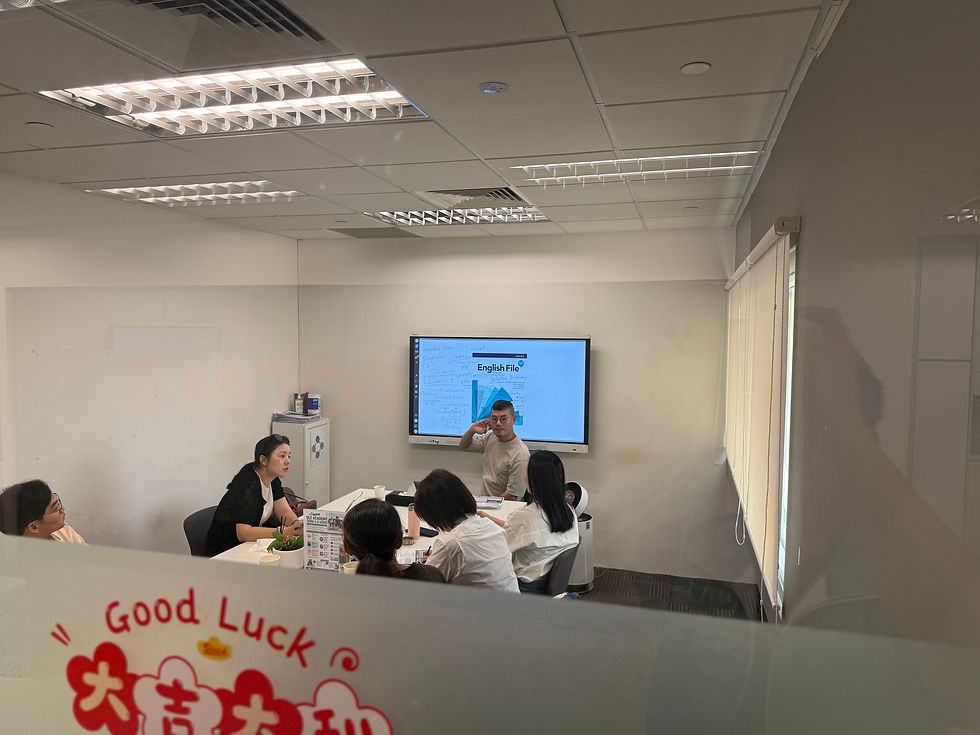
ULC Academy offers adult English small-group classes at our Orchard campus, 111 Somerset Road, #12-22 TripleOne Somerset. Classes start from S$20/hour, and morning classes run Monday to Friday, 10:00 AM–12:00 PM — while your child is at school. In class, you can practise exactly these situations: ordering at a hawker centre, describing symptoms at the clinic, and making a phone appointment, through role-play with a teacher who corrects you gently.
Find out more about our adult English courses, or WhatsApp us at +65 9660 9969 to book your free trial class.
ULC Academy is rated 4.9/5 on Google.


Comments