Accompanying Mothers' English, Part 2: School Communication — Notices, Emails and Parent-Teacher Meetings


This is part two of our four-part series for accompanying mothers in Singapore. Part one covered the path from zero beginner to daily communication. Now we turn to the place where English matters most for a mother: your child's school.
A school letter in the school bag, an email from a teacher, a parent-teacher meeting on the calendar — these moments make many mothers anxious. The good news is that school English is a small, predictable world: the same words, the same letters every term, and a handful of polite phrases for almost every situation.
Reading school notices: the words that keep coming back
Singapore schools send home a lot of paper and email — permission slips, excursion notices, CCA information, exam timetables, holiday reminders. The letters look formal, but most use the same small set of words.
Start with the words that decide what you must do:
· Permission slip / consent form — the form you sign to allow your child to join an activity, such as a school trip.
· Excursion / learning journey — a school trip outside the school.
· CCA — co-curricular activities, such as sports, clubs or music, usually after school.
· Term break / school holiday — the break between school terms. Singapore schools have four terms a year.
· Dismissal time — the time school ends.
· Assembly — a gathering of the whole school, often in the morning.
· Parent-teacher meeting (PTM) — a meeting with your child's teacher about progress.
· Report book / report card — the written report of your child's results.
You do not need to understand every word in a notice. Look for four things first: what is happening, when, where, and what you need to do — usually "please sign and return by [date]" or "please reply by email". The date and the action matter most.
Keep a small phrase notebook: each time a new word appears in a school letter, write it down with its meaning and one example sentence. After one term you will have almost all the school vocabulary you need.
Writing emails to teachers: short, polite and clear
Many mothers worry most about writing to a teacher. But school emails are short and follow a fixed pattern, and teachers in Singapore value clarity over perfect grammar.
A simple structure works for almost every school email: a greeting ("Dear Ms Tan,"), one line saying who you are ("I am Mei's mother."), your reason in one or two sentences, and a polite closing ("Thank you for your time." Then "Best regards," and your name.)
Here are templates you can adapt.
Your child is sick and cannot come to school:
> Dear Ms Tan,
>
> I am writing to let you know that Mei is unwell today and will not be able to come to school. She has a fever. We will see a doctor today.
>
> Thank you for your understanding.
>
> Best regards,
> Li Hua
Asking about your child's progress:
> Dear Mr Lee,
>
> I am Wei's mother. I would like to ask how Wei is doing in English class. Is there anything he should practise more at home?
>
> Thank you very much.
>
> Best regards,
> Chen Wei
Requesting a meeting with the teacher:
> Dear Ms Tan,
>
> I am Mei's mother. I would like to meet you to talk about Mei's progress at school. Could we meet sometime next week? I am free in the mornings.
>
> Thank you.
>
> Best regards,
> Li Hua
Three rules make these emails work: keep them short, say one thing per email, and always include your child's name and class, for example "Mei, Primary 3A".
Parent-teacher meetings: what to expect and what to say
A parent-teacher meeting usually lasts 10 to 15 minutes. The teacher talks about how your child is doing — in classwork, behaviour, and with friends — and may show you the report book. There is usually time for your questions at the end.
You do not need fluent English. The best preparation is to write down three or four questions beforehand:
· "How is my child doing in class?"
· "What is my child's strongest subject?"
· "What should we practise more at home?"
· "How is my child getting on with classmates?"
· "Is there anything I should know about next term?"
If you do not understand something the teacher says, these phrases are completely normal — every parent uses them:
· "Sorry, could you say that again, please?"
· "Could you speak a little more slowly, please?"
· "Could you write that down for me, please?"
· "I understand — thank you."
If something important needs to be fully understood — a decision about your child's class, for example — say, "Could I have this in writing, please?" A written note lets you read it carefully at home. You can also ask the school office whether a translated summary of important notices is available.
Practical tips for school English
Use the parent portal. Most Singapore schools have an online parent portal or app for notices, timetables and messages from teachers. Check it once or twice a week.
Keep everything in one place. Keep school letters in one folder — paper or on your phone — newest on top. Photograph paper letters so you always have a copy.
Practise the phrases out loud. Read your email template aloud before sending it, and say your meeting questions aloud at home.
Learn with other mothers. The mothers at the school gate are often in the same situation. Sharing translations of a confusing notice, or practising a meeting question together, helps everyone.
School English is learnable — one letter at a time
School communication feels hard because it matters so much: it is about your child. But it is also one of the most learnable parts of English — small vocabulary, repeating letters, the same phrases every term. Each notice you decode and each email you send makes the next one easier.
In part three of this series, we will look at daily-life English beyond the school — shopping, the doctor, and everyday errands.
How ULC Academy can help
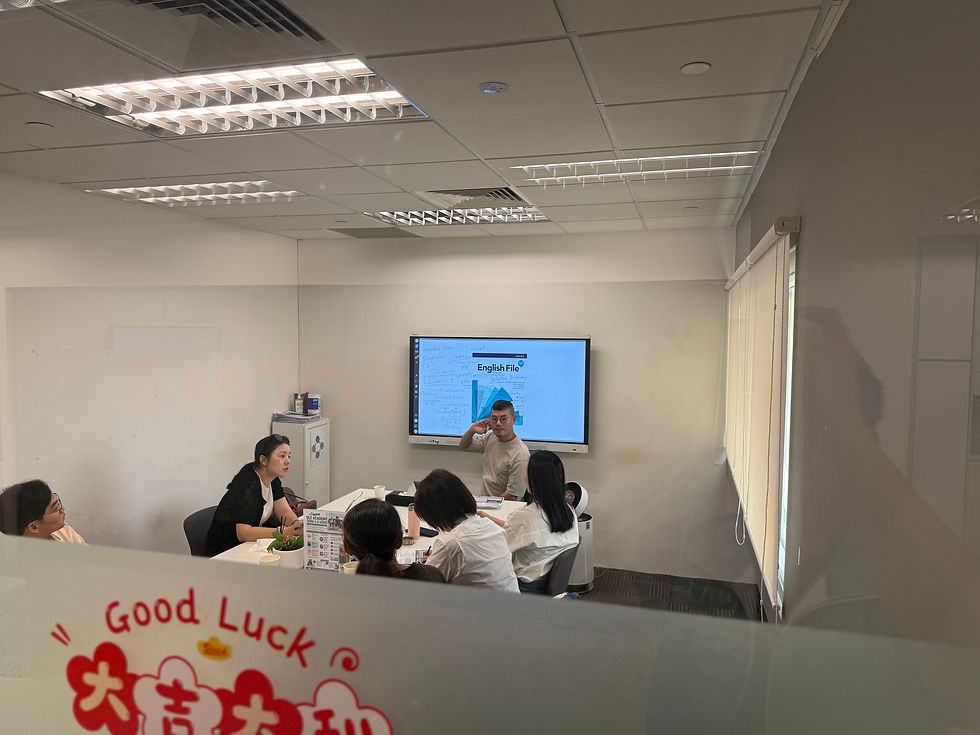
ULC Academy offers adult English small-group classes at our Orchard campus, 111 Somerset Road, #12-22 TripleOne Somerset. Classes start from S$20/hour, and morning classes run Monday to Friday, 10:00 AM–12:00 PM — while your child is at school. In class, you can practise exactly these situations: reading a real school notice, writing an email to a teacher, and role-playing a parent-teacher meeting, with a teacher who corrects you gently.
Find out more about our adult English courses, or WhatsApp us at +65 9660 9969 to book your free trial class.
ULC Academy is rated 4.9/5 on Google.


Comments