Accompanying Mothers' English: From Zero Beginner to Daily Communication


You moved to Singapore so your child could study here. Now every day asks you to do it all in English: the school gate, the hawker centre, the clinic, the parent-teacher meeting. If your English is at zero, or close to it, that can feel overwhelming. It is also completely normal — and fixable, step by step.
This is part one of a four-part series for accompanying mothers: from zero beginner to daily communication.
Who this is for
This series is for mothers who came to Singapore with their school-age children — from China, Taiwan, Japan, Korea, Portugal or Brazil — and are starting English from zero or near-zero. Perhaps you studied it years ago; perhaps never at all.
Your goal is practical, not an exam: live your life here without translation apps or your child interpreting for you. You want to talk to your child's teacher, ask a question at the clinic, order food, and chat with the other parents at the school gate. That needs a different path from exam English: speaking and listening in real situations.
Starting from zero as an adult is normal — and workable
Many accompanying mothers feel embarrassed about starting from zero as an adult. They imagine everyone else arrived fluent. The truth is that many mothers in Singapore started exactly where you are. English is a skill, not a talent, and adults learn it every day.
Adults have advantages, too: you know how to learn, and you know exactly which situations you need English for. You do not need to learn everything — just the English of your own daily life: the school, the supermarket, the clinic, the bus. And progress at the start is fast. The first hundred words and the first twenty sentences you can say without thinking change your daily life more than anything you learn later.
A realistic three-stage path
Think of the journey in three stages.
Stage 1: Survival phrases. In the first few weeks, the goal is simple: get through the day. Learn the phrases that unlock everyday situations — greetings, numbers, "How much is this?", "Where is…?", "I would like…", "My child is sick today" — and learn to understand the most common answers: prices, times, directions. The point is never being stuck.
Stage 2: Everyday conversations. After a few months of steady practice, the goal shifts: hold short, real conversations. Introduce yourself to another parent, ask the teacher how your child is doing, or explain a symptom at the clinic.
Stage 3: Confident independence. Over time, the goal becomes handling new situations without rehearsing them first: a parent-teacher meeting, a phone call to the school office, a conversation with a doctor. The difference is that mistakes no longer stop you. That is confident independence — not perfect English, but English that works.
Your first-month starter plan
Practise the English of your actual day. Here is a first-month plan built around the places you already go.
Week 1: The school gate. Learn to greet other parents and teachers, introduce yourself and your child, and say the essential school phrases: "Good morning", "How are you?", "My child is in Primary 3", "See you tomorrow." Say them out loud every day, even alone at home.
Week 2: The hawker centre and the supermarket. Food and shopping are the easiest places to practise. Learn numbers, prices and food words, and the phrases "I would like…", "How much?", "Take away, please", "No chilli, please." Order something different every day.
Week 3: The MRT, the bus and directions. Learn to ask where things are and to understand the answers: "Which platform for Orchard?", "Does this bus go to Somerset?", "Excuse me, where is the clinic?"
Week 4: The clinic and other parents. Learn the words for common symptoms — fever, cough, stomachache, headache — and the phrases "My child has a fever", "I need to see a doctor", "When can I come back?" Also practise one open question for other parents, such as "How long have you lived in Singapore?"
Do a little every day rather than a lot once a week: twenty minutes of speaking practice a day beats three hours on a Sunday.
Three common mistakes to avoid
Memorising word lists without speaking. A thousand words you have never said out loud will not help you order lunch. Words only become useful when you speak them.
Waiting to feel "ready". Confidence comes from speaking, not before it — so speak from week one, mistakes and all.
Translating everything in your head. If you translate every sentence from your own language before speaking, you will always be slow and stressed. Instead, learn whole phrases as units: "I would like a coffee" as one piece.
How small-group speaking classes help
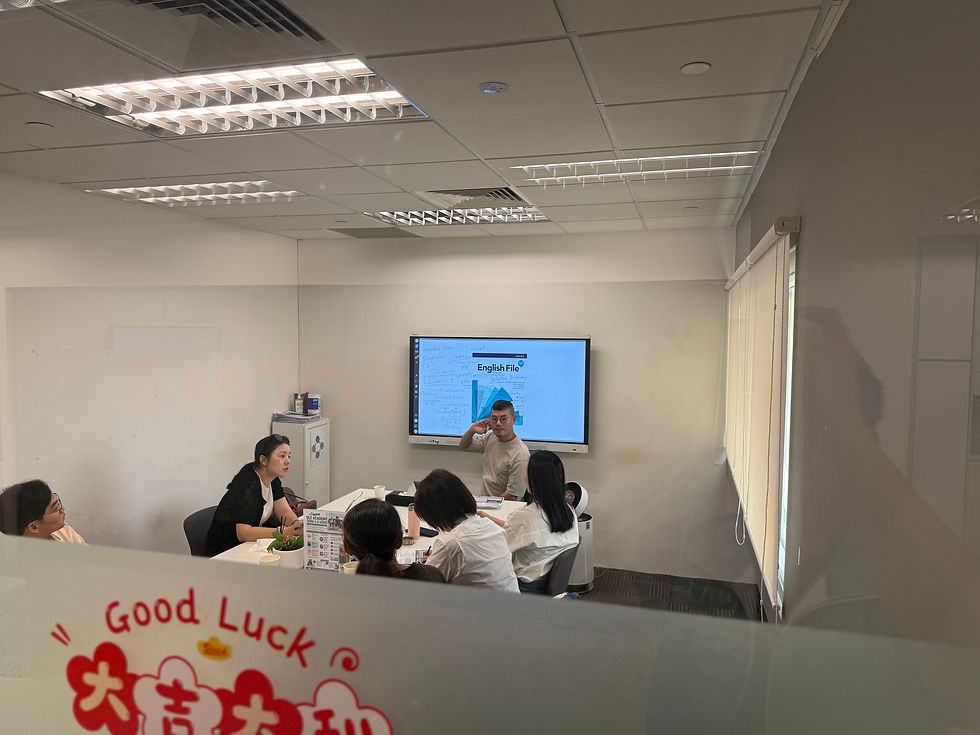
Self-study can take you a long way, but speaking needs other people. A small-group speaking class gives you what practising alone cannot: real conversation, a teacher who corrects you gently, and classmates at your level making the same mistakes. You practise the situations you actually face — the school gate, the clinic, the hawker centre. Because the group is small, you speak in every lesson.
How ULC Academy can help
ULC Academy offers adult English small-group classes at our Orchard campus, 111 Somerset Road, #12-22 TripleOne Somerset. Classes start from S$20/hour, and morning classes run Monday to Friday, 10:00 AM–12:00 PM — while your child is at school.
Find out more about our adult English courses, or WhatsApp us at +65 9660 9969 to book your free trial class.
ULC Academy is rated 4.9/5 on Google.


Comments